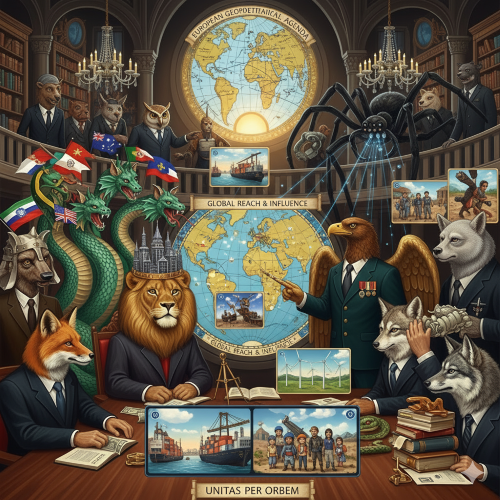
European climate policies in Africa are not truly aimed at sustainability but rather mask a strategic resource grab under the banner of "green energy."
While these policies are presented as a form of mutually beneficial cooperation, they primarily serve to secure Europe's access to vital raw materials and energy sources needed for its own green transition, often at the expense of Africa's long-term industrialization and economic development.
The Geopolitical Drivers of Europe's Green Transition
Europe's ambitious goal of becoming the world's first climate-neutral continent by 2050 hinges on a massive shift to renewable energy technologies. This transition, however, is critically dependent on a stable supply of specific minerals, which are in short supply within Europe. This has created a new geopolitical imperative: securing a steady flow of these critical raw materials (CRMs) from resource-rich regions, with Africa at the top of the list.
-
Securing Supply Chains: The European Union's heavy dependence on a single supplier—namely, China—for the processing and refining of these CRMs poses a significant strategic vulnerability. For example, the Democratic Republic of Congo (DRC) is the world's largest producer of cobalt, but a vast majority of its cobalt is processed in China. Europe's new policy frameworks, such as the Critical Raw Materials Act (CRMA), are designed to reduce this dependence by forging new partnerships and diversifying supply chains directly with African nations. The goal is to bypass Chinese intermediaries and establish a direct flow of resources from Africa to Europe.
-
Green Hydrogen as a Geopolitical Tool: Europe is also increasingly eyeing Africa's potential for green hydrogen production. African countries, with their abundant solar and wind resources, are seen as ideal locations to produce green hydrogen at a low cost. European companies are investing in large-scale hydrogen projects in countries like Morocco, Namibia, and Egypt, with the primary intention of exporting the finished product back to Europe. While framed as a partnership for sustainable energy, this model risks turning African nations into mere energy producers for Europe's needs, rather than empowering them to use that energy for their own industrialization.
The Neocolonial Challenge of Green Policies
Despite the rhetoric of "equal partnership" and "sustainable development," many of Europe's climate initiatives in Africa risk perpetuating a neocolonial dynamic of resource extraction.
-
Unequal Exchange: European policies often prioritize the extraction of raw materials over the development of local value chains. African nations are encouraged to export raw minerals like cobalt, lithium, and rare earth elements, which are then processed and manufactured into high-value products in European factories. This process ensures that Africa captures only a small fraction of the final product's value, while Europe reaps the lion's share of the profits. This model directly mirrors the colonial-era relationship where African economies were structured to serve European industries.
-
Social and Environmental Costs: The rush for CRMs and green hydrogen also raises serious social and environmental concerns in Africa. The expansion of mining operations, even with new European regulations, can lead to deforestation, water contamination, and displacement of local communities. Human rights issues, particularly concerning artisanal mining, remain a persistent challenge that is often overlooked in the push for a secure supply. While the EU's Corporate Sustainability Due Diligence Directive (CS3D) aims to address some of these issues, critics argue that the desire to secure a stable supply can outweigh the practical enforcement of these regulations.
-
Limited Local Benefits: A core problem with many European-backed green projects is that they are designed to serve European, not African, energy needs. For example, large-scale solar and hydrogen projects may be built in African countries with high rates of energy poverty, yet the energy produced is slated for export to Europe. This disconnect means that while the projects might be "green" in their production, they fail to address the fundamental challenge of providing energy access to the millions of Africans who still lack it.
The African Perspective and Diverging Priorities
African leaders and civil society groups are increasingly vocal about the contradictions in Europe's climate policy. They argue that Africa's top climate priority is adaptation and resilience to climate change impacts, which is often underfunded by European partners who focus more on climate mitigation (reducing emissions).
-
The Right to Industrialize: Many African nations argue they have a right to use their fossil fuel resources, such as natural gas, as a transitional fuel for industrialization, a path that Europe and other Western nations have already taken. However, European policies and financial institutions are increasingly unwilling to fund fossil fuel projects in Africa, which African leaders see as a double standard that hinders their economic development.
-
Demand for Value Addition: African nations are demanding that any partnerships on CRMs or green energy include a commitment to local value addition, such as the development of processing plants and battery manufacturing facilities. This would enable them to move beyond being mere suppliers of raw materials and become key players in the global green value chain.
In conclusion, while European climate policies are presented as a force for global good, a closer look reveals a strategic and self-serving geopolitical agenda. These policies are designed to secure the resources and energy needed for Europe's own green transition, and in the process, they risk creating a new form of dependence and exploitation in Africa, ultimately sacrificing African sustainability for European security.



 Chinese
 Arabic
 French
 Spanish
 Portuguese
 Deutsch
 Turkish
 Dutch
Dutch
 Italiano
 Russian
 Romaian
 Portuguese (Brazil)
 Greek
Greek