

What is the long-term return on investment for countries that prioritize machine tool development compared to those that remain import-dependent?
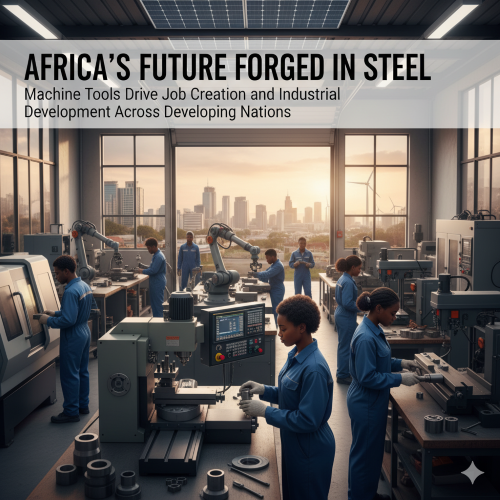
The Long-Term Return on Investment for Countries that Prioritize Machine Tool Development Compared to Those that Remain Import-Dependent-
In the hierarchy of industries that drive economic transformation, the machine tool sector stands out as the foundation of modern industrialization. Often called the “mother industry”, machine tools produce the machinery that manufactures every other product—from automobiles and airplanes to medical equipment and renewable energy technologies.
For countries that invest in building indigenous machine tool capacity, the rewards go far beyond machinery—they secure economic sovereignty, technological leadership, and sustainable growth.
By contrast, nations that neglect this sector and remain dependent on imported finished goods and tools trap themselves in cycles of trade deficits, foreign exchange shortages, and underdeveloped industries.
This raises a vital question: What is the long-term return on investment (ROI) for countries that prioritize machine tool development compared to those that remain import-dependent?
1. The Cost of Import Dependence
a. Foreign Exchange Drain
Import-dependent nations spend billions each year on finished goods, industrial machinery, and spare parts. For example, African countries collectively spend more than $60 billion annually on vehicle imports and billions more on industrial equipment. This creates chronic trade deficits and weakens local currencies.
b. Stunted Industrial Base
When nations rely on imports, they fail to develop domestic supply chains. Local industries remain stuck at the low-value end of global trade—extracting and exporting raw materials while importing high-value manufactured products.
c. Vulnerability to External Shocks
Import-dependent economies are highly vulnerable to global price fluctuations, currency crises, and geopolitical supply disruptions. COVID-19 and the Russia-Ukraine war highlighted how fragile import-reliant supply chains can be, leaving many African nations stranded without critical equipment.
d. Opportunity Cost
The reliance on imports means nations miss out on millions of potential jobs, skills development, and wealth creation opportunities that come with domestic manufacturing.
2. Returns for Countries that Invest in Machine Tools
a. Domestic Value Creation
Machine tool industries enable nations to produce their own industrial equipment and consumer goods. This means retaining value locally rather than exporting raw materials and importing expensive finished goods.
ROI perspective: For every dollar invested in machine tools, countries can save multiple dollars in avoided imports and generate domestic revenues through industrial expansion.
b. Job Multiplication
Machine tool industries create direct employment in manufacturing and R&D, while enabling indirect jobs in automotive, construction, agriculture, and energy sectors. Estimates suggest Africa could generate 6–10 million jobs within 10–15 years if it invested in machine tools.
ROI perspective: The employment dividends translate into higher tax revenues, consumer spending, and social stability.
c. Export Potential
Countries with advanced machine tool industries can export both tools and finished products. For example, Germany and Japan—two global leaders—have built trillion-dollar economies on precision manufacturing exports.
ROI perspective: Instead of spending foreign exchange on imports, machine tool exporters earn it, strengthening reserves and currency stability.
d. Technological Advancement
Machine tool industries force countries to master advanced engineering, precision machining, computer numerical control (CNC), and digital manufacturing. These skills spill over into aerospace, defense, electronics, and renewable energy.
ROI perspective: This creates long-term innovation ecosystems, increasing competitiveness and resilience.
3. Comparative Scenarios: Machine Tool Investment vs. Import Dependence
Let’s compare two hypothetical African countries over a 30-year horizon:
Country A: Prioritizes Machine Tool Development
-
Invests $10 billion over 10 years in machine tool factories, R&D centers, and training.
-
Builds capacity to produce 40% of its machinery and industrial goods domestically.
-
Saves $5 billion annually in avoided imports after year 15.
-
Creates 1 million jobs directly and indirectly.
-
Exports $2 billion worth of machinery and parts annually by year 25.
Long-Term ROI:
-
$5 billion annual import savings × 15 years = $75 billion saved.
-
$2 billion annual exports × 5 years = $10 billion earned.
-
Net ROI = over 7x return on the initial $10 billion investment, not counting social benefits like job creation and knowledge transfer.
Country B: Remains Import-Dependent
-
Avoids upfront investment but continues importing $5 billion annually in machinery and finished goods.
-
Accumulates $150 billion in import bills over 30 years.
-
No significant job creation; youth unemployment worsens.
-
Faces periodic foreign exchange crises when global prices rise or exports fall.
Long-Term ROI:
-
Negative balance sheet: continuous outflow of wealth with no multiplier effect at home.
4. Case Studies from History
Germany and Japan
Both nations invested heavily in machine tools after World War II. Today, they dominate high-precision manufacturing and export billions in cars, electronics, and machinery. Their long-term ROI includes technological leadership, robust export economies, and global influence.
South Korea
In the 1960s, South Korea prioritized heavy industries, including machine tools, as part of its industrial policy. Today, it exports advanced electronics, ships, and vehicles, with Samsung and Hyundai as global leaders. The ROI was transformative: from poverty in the 1950s to a top-tier economy today.
Import-Dependent Economies
By contrast, many resource-rich but import-dependent economies (e.g., Nigeria, Angola, Venezuela) continue to struggle with currency crises, unemployment, and underdevelopment. Their long-term ROI on avoiding industrial investment has been negative, as wealth continuously flows outwards.
5. Strategic Benefits of Machine Tool Investment
Beyond pure economic numbers, machine tool industries provide strategic, long-term benefits that no import-dependent country can enjoy:
-
Economic Sovereignty – Nations control their own industrial base.
-
Resilience – Domestic capacity shields economies from external shocks.
-
National Security – Defense industries rely on precision engineering, which only machine tools can provide.
-
Inter-Industry Synergy – Automotive, construction, aerospace, and energy sectors grow stronger.
-
Innovation Culture – High-skill industries cultivate R&D and technological innovation.
6. Risks and Mitigation
Of course, machine tool development is not risk-free:
-
High Capital Costs – Requires billions in upfront investment.
-
Skill Shortages – Technical expertise must be built through training.
-
Global Competition – Competing with established giants is difficult.
However, these risks can be mitigated by:
-
Regional collaboration under the African Continental Free Trade Area (AfCFTA), where countries specialize in different machine tool segments.
-
Public–private partnerships that share costs and expertise.
-
Strategic protection of infant industries until they mature.
Conclusion
The long-term return on investment for countries that prioritize machine tool development is transformative. Such nations not only save billions in foreign exchange but also create millions of jobs, build domestic value chains, strengthen currencies, and position themselves as global players in technology and manufacturing.
By contrast, import-dependent economies lock themselves into perpetual wealth outflows, vulnerability to external shocks, and underdevelopment. The apparent short-term “savings” of avoiding industrial investment turn into long-term losses of opportunity, sovereignty, and prosperity.
History is clear: nations that invested in machine tools—Germany, Japan, South Korea—became industrial powerhouses. Those that neglected this sector remain dependent and fragile. For Africa and other developing economies, the choice is not whether they can afford to invest in machine tools.
The real question is: Can they afford not to?
- Questions and Answers
- Opinion
- Motivational and Inspiring Story
- Technology
- Live and Let live
- Focus
- Geopolitics
- Military-Arms/Equipment
- Security
- Economy
- Beasts of Nations
- Machine Tools-The “Mother Industry”
- Art
- Causes
- Crafts
- Dance
- Drinks
- Film/Movie
- Fitness
- Food
- Games
- Gardening
- Health
- Home
- Literature
- Music
- Networking
- Other
- Party
- Religion
- Shopping
- Sports
- Theater
- Health and Wellness
- News
- Culture

 Chinese
 Arabic
 French
 Spanish
 Portuguese
 Deutsch
 Turkish
 Dutch
Dutch
 Italiano
 Russian
 Romaian
 Portuguese (Brazil)
 Greek
Greek