

Could Africa leapfrog into modern “smart manufacturing” (CNC, robotics, AI-driven production) by building machine tool capacity now?
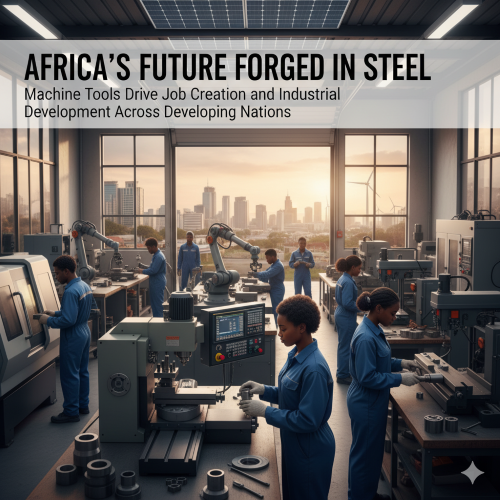
Can Africa Leapfrog into Smart Manufacturing by Building Machine Tool Capacity?
"Africa could leapfrog into modern “smart manufacturing” — CNC, robotics, and AI-driven production — by building machine tool capacity now"
For decades, Africa’s industrial development has lagged behind other regions, with economies often stuck in the role of raw material exporters rather than producers of high-value goods. But as the global manufacturing landscape shifts toward Industry 4.0 — smart factories powered by CNC (computer numerical control), robotics, IoT, and artificial intelligence — Africa faces both a challenge and an opportunity. The central question is: can Africa leapfrog traditional industrial pathways and embrace smart manufacturing directly, provided it invests in machine tool capacity now?
This article argues that while leapfrogging is possible, it requires deliberate strategies centered around machine tools — the mother industry — combined with skill development, infrastructure, and innovation ecosystems.
1. Understanding Smart Manufacturing
Smart manufacturing, often described as Industry 4.0, refers to a highly digital, automated production environment where machines communicate, optimize processes in real-time, and integrate data-driven decision-making.
Key features include:
-
CNC machines for precision machining.
-
Robotics for automated assembly, welding, and packaging.
-
AI algorithms for predictive maintenance, supply chain optimization, and quality control.
-
IoT-enabled sensors that collect data for real-time monitoring.
-
Additive manufacturing (3D printing) for prototyping and flexible production.
Countries like Germany, Japan, South Korea, and increasingly China have embraced this model, positioning themselves at the frontier of global industry.
2. The Case for Leapfrogging
Africa has historically been late to industrial revolutions. During the first and second industrial revolutions (steam engines and electricity-driven mass production), most of the continent was under colonial rule. In the third industrial revolution (automation and electronics), African economies were still primarily resource-based.
However, leapfrogging — bypassing intermediate stages to adopt advanced technologies — is not impossible. Africa already demonstrated this in telecommunications: many countries skipped fixed-line infrastructure and went straight to mobile phones and mobile banking, with Kenya’s M-Pesa becoming a global benchmark.
The same principle could, in theory, apply to manufacturing. Instead of trying to replicate the low-cost, labor-intensive industrial model of Asia, Africa could focus on smart, flexible, high-value production.
3. Why Machine Tools Are the Key Enabler
Machine tools form the foundation of smart manufacturing. Without the ability to produce, maintain, and innovate machine tools, Africa would remain dependent on imports, undermining any attempt at industrial independence.
Here’s why machine tools matter:
-
CNC Machines: CNCs are essentially advanced machine tools with embedded digital control. Building local capacity in CNC design and operation ensures Africa is not locked into outdated manual systems.
-
Robotics Manufacturing: Industrial robots rely on precision components (actuators, gears, frames) often made using machine tools.
-
AI Integration: For AI-driven factories to work, there must be hardware capable of collecting and responding to data — machine tools provide that hardware base.
-
Customization for Local Needs: Africa’s industries often operate under unique conditions — erratic power supply, dust, humidity, and infrastructure challenges. Local machine tool industries can adapt global technologies to fit these realities.
Without this foundation, Africa risks importing smart manufacturing equipment wholesale — expensive, difficult to maintain, and unsuitable for local contexts.
4. Opportunities for Africa in Smart Manufacturing
a) Automotive Industry
With countries like South Africa, Morocco, Nigeria, and Kenya growing automotive assembly, machine tool capacity would allow Africa to move from assembling imported kits to producing engines, chassis, and precision parts locally. CNC machining and robotics are central to this.
b) Agriculture and Food Processing
Smart manufacturing can automate the production of tractors, harvesters, irrigation systems, and food-processing equipment. Machine tools would ensure Africa doesn’t just import machinery but builds and maintains it.
c) Renewable Energy
Africa is investing heavily in solar, wind, and hydro power. Smart manufacturing can localize production of turbine parts, solar panel frames, and batteries. Without machine tools, these industries will depend on imports.
d) Construction and Infrastructure
From steel beams to prefabricated housing units, robotics and CNC systems can revolutionize African construction. Locally built machine tools would reduce costs and foreign dependence.
5. Challenges Africa Must Overcome
While the opportunity exists, leapfrogging into smart manufacturing is not automatic. Key challenges include:
-
Skills Gap: Operating and programming CNC machines or integrating AI requires advanced technical skills. Africa must expand vocational training, polytechnic education, and university research.
-
Capital Investment: Smart factories require significant upfront investment in equipment, infrastructure, and R&D. Many African economies face budgetary constraints.
-
Infrastructure Deficits: Smart factories depend on reliable electricity, internet connectivity, and transport networks. Many regions lack these basics.
-
Policy & Regulation: Weak industrial policies and inconsistent governance can discourage investment. Governments need coherent frameworks that prioritize industrialization.
-
Global Competition: Countries like China and India already dominate smart manufacturing. Africa must identify niches rather than competing head-on.
6. Pathways for Africa to Leapfrog
Despite these challenges, Africa can chart a realistic pathway into smart manufacturing:
Step 1: Build Machine Tool Ecosystems
-
Establish regional machine tool hubs (West, East, Southern Africa).
-
Encourage SMEs to produce basic machine tools (lathes, presses, CNC kits) while importing advanced systems.
-
Support joint ventures with foreign machine tool companies to localize production.
Step 2: Invest in Skills Development
-
Expand vocational training centers to teach CNC operation, robotics maintenance, and CAD/CAM design.
-
Strengthen polytechnics for applied engineering projects.
-
Fund universities for R&D in robotics, AI, and advanced manufacturing materials.
Step 3: Develop Industrial Clusters
-
Create industrial parks where machine tool companies, suppliers, and users co-locate.
-
Provide tax incentives and infrastructure to attract investors.
Step 4: Target Niche Markets
-
Instead of trying to replicate Germany or China, Africa could focus on producing low-cost CNC machines adapted to African SMEs.
-
Develop smart manufacturing solutions for agriculture, food processing, and renewable energy — sectors with huge local demand.
Step 5: Leverage Digital Tools
-
Promote open-source CNC designs and affordable AI software tailored for small enterprises.
-
Encourage 3D printing in local innovation hubs to support prototyping.
7. Long-Term Benefits of Leapfrogging
If Africa successfully builds machine tool capacity and integrates smart manufacturing, the benefits would be transformative:
-
Reduced Import Dependence: Instead of importing machinery and finished goods, Africa would produce locally.
-
Job Creation: New industries in robotics, AI, and machine tools would create skilled jobs for youth.
-
Foreign Exchange Savings: Local production would save billions spent on machinery imports.
-
Technological Sovereignty: Africa would not just be a consumer but also a contributor to global Industry 4.0 innovation.
-
Sustainable Development: Smart manufacturing can support green industries, reducing environmental impact.
8. Conclusion
Africa faces a unique crossroads. On one hand, it risks being left behind once again if it fails to invest in machine tools and smart manufacturing. On the other hand, by building machine tool capacity now, the continent has the chance to leapfrog into Industry 4.0, skipping decades of incremental industrial development.
The key is to act with urgency: build machine tool industries, align education with modern manufacturing, create industrial clusters, and harness digital technologies. If Africa seizes this opportunity, it can transform its role in the global economy from raw material supplier to smart manufacturer.
In short, machine tools are Africa’s ticket to leapfrogging into the future.
_________________________________________
www.ubuntusafa.com
“Industrial wisdom is not about who finds the minerals, but who transforms them.”
- Questions and Answers
- Opinion
- Motivational and Inspiring Story
- Technology
- Live and Let live
- Focus
- Geopolitics
- Military-Arms/Equipment
- Безопасность
- Economy
- Beasts of Nations
- Machine Tools-The “Mother Industry”
- Art
- Causes
- Crafts
- Dance
- Drinks
- Film/Movie
- Fitness
- Food
- Игры
- Gardening
- Health
- Главная
- Literature
- Music
- Networking
- Другое
- Party
- Religion
- Shopping
- Sports
- Theater
- Health and Wellness
- News
- Culture

 Chinese
 English
 Arabic
 French
 Spanish
 Portuguese
 Deutsch
 Turkish
 Dutch
Dutch
 Italiano
 Romaian
 Portuguese (Brazil)
 Greek
Greek