

Pakistan’s JF-17 Block III Fighters Touch Down In Azerbaijan; Fly Non Stop For Indus Shield Alpha Drills

Pakistan’s JF-17 Block III fighter jets arrived in Azerbaijan to participate in aerial combat drills, underscoring the deepening of military ties between the two allies.
When the JF-17 Block III was first spotted in Azerbaijan, there were speculative reports that the South Caucasian country had received a fresh batch of jets for induction into its Air Force.
However, Pakistan’s military wing, Inter-Services Public Relations (ISPR), later announced that the JF-17 belonging to the Pakistan Air Force (PAF) had touched down in Azerbaijan to participate in a bilateral aerial combat exercise.
The exercise, called “Indus Shield Alpha”, aims to bolster mutual understanding, tactical coordination, and interoperability between the air forces of Pakistan and Azerbaijan, the ISPR said in a statement, as reported by Pakistani newspaper Dawn.
“In a remarkable display of operational prowess and endurance, PAF fighters accomplished a non-stop flight from their home base in Pakistan to Azerbaijan, executing flawless in-flight air-to-air refuelling operations,” the statement read.
“The intricate mid-air refuelling operation, executed with utmost precision by PAF’s own IL-78 aerial tanker, reaffirmed the long-range capability of PAF fighter jets and showcased the professional excellence and preparedness of PAF aircrew to undertake extended international deployments,” it added.
According to the ISPR statement, the exercise will focus on modern aerial warfare strategies, collaborative mission planning, and execution in a setting influenced by rapidly changing airpower dynamics and technical breakthroughs. Further, it emphasized that the bilateral exercise will be an essential forum for exchanging operational knowledge and enhancing teamwork in addressing new aerial defense challenges.
“The participation of the Pakistan Air Force contingent in Exercise Indus Shield Alpha reaffirms PAF’s enduring commitment to regional stability and global military cooperation,” it stated. “It also demonstrates PAF’s unwavering resolve to continuously evolve and adapt to the demands of contemporary warfare, while maintaining its tradition of excellence in every domain of air operations.”
Azerbaijan and Pakistan are close allies, and part of a cohort that also includes Turkey. In fact, Islamabad received extensive support and backing from Baku and Ankara during the four-day Indo-Pakistan border conflict fought in May this year.
Although the conflict was triggered after India launched ‘Operation Sindoor’ in retaliation for the Pahalgam terror attack, Azerbaijan issued formal statements condemning India’s military strikes and offered condolences to slain Pakistanis.
During the brief four-day conflict, the PAF fielded a “networked force package” including JF-17 Block IIIs, J-10CE fighters, electronic warfare assets, and airborne early warning platforms.
The JF-17s, for one, were reportedly used for air-to-air intercepts, ground strikes, as well as disrupting Indian advances. However, they did not perform as admirably as the Pakistani top generals may have expected, according to reports.
Interestingly, the Indian Air Force (IAF) chief Air Chief Marshal A.P. Singh announced earlier this month that the IAF had destroyed 12 to 13 Pakistani aircraft, including 9-10 fighter jets, during the conflict.
Among these were four to five high-tech fighters, including the US-made F-16s and Chinese co-produced JF-17s, with an additional four to five F-16s destroyed in the hangar, likely under maintenance.
Pakistani media praised the JF-17 Block III, highlighting that the aircraft was awarded the “Spirit of the Meet Trophy” for its “striking livery and the incredible journey from Pakistan with non-stop air-to-air refuelling” at the Royal International Air Tattoo (RIAT) 2025 in the UK in July 2025.
However, experts believe that India’s claims about the J-17 losses could dent its export potential and deal a big blow to Pakistan and China, the developers of JF-17.
In September last year, Azerbaijan disclosed that the JF-17 Block III aircraft had been inducted into service. The aircraft was presented to Ilham Aliyev, the President and Supreme Commander-in-Chief of Azerbaijan, at Heydar Aliyev International Airport.
“The jets have already been integrated into the arsenal of Azerbaijan’s Air Force,” read a statement from the President’s office.
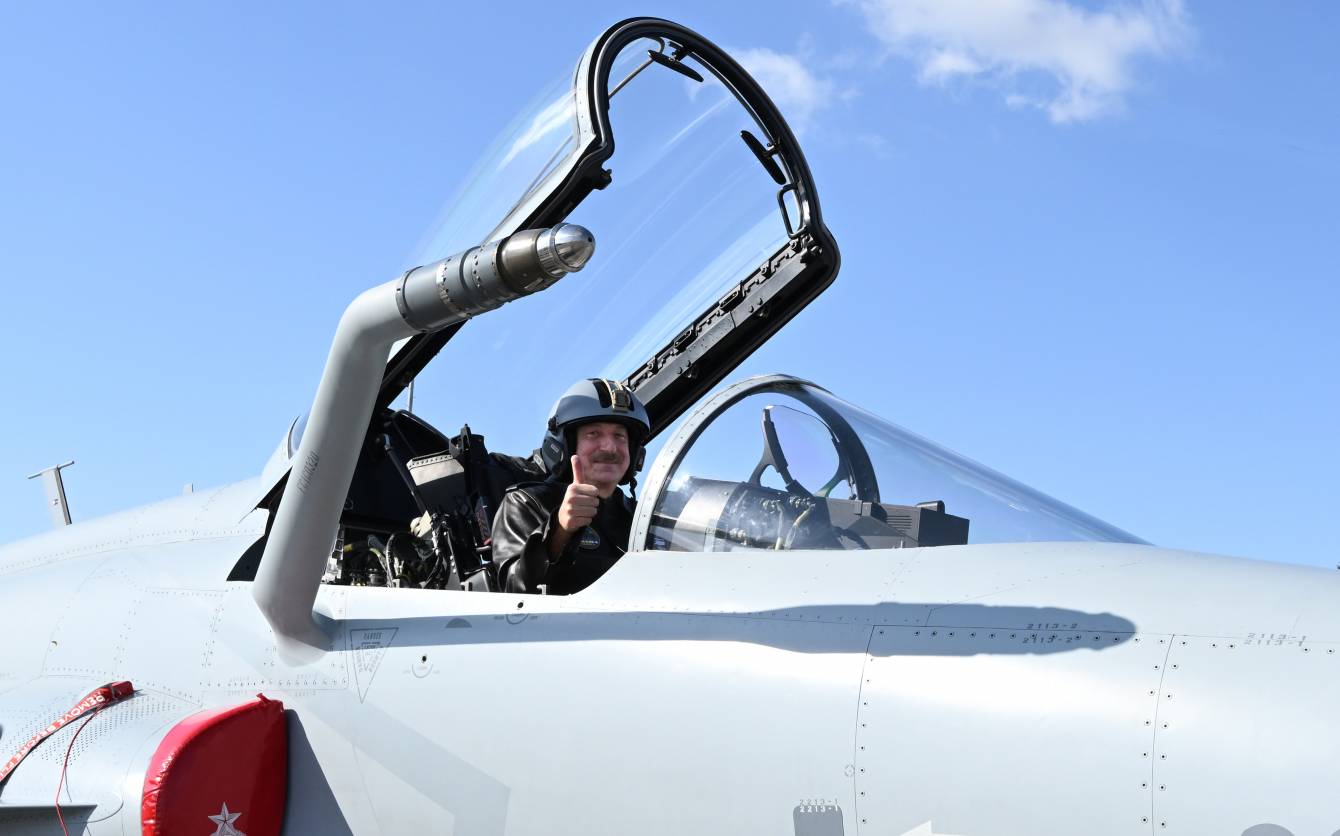
Some reports published in June 2025 suggested that Azerbaijan had finalized a $4.6 billion contract for 40 JF-17 Block III jets, the largest single export order for Pakistan’s Aeronautical Complex (PAC).
The acquisition of JF-17 Block III by Azerbaijan is aimed at augmenting its combat capability and readiness in the face of sustained tension with Armenia, with which it has fought multiple conflicts over the years.
In fact, Yerevan has allegedly been eyeing the Indian Su-30MKI fighter jet in a bid to bolster its existing Su-30 fleet and pose a credible challenge to the significant advancement in Azerbaijan’s Air Force. You can read a detailed EurAsian Times report on the issue here.
JF-17 Block III Fighters
The JF-17 Thunder is a single-engine multirole combat aircraft jointly developed by Pakistan Aeronautical Complex (PAC) and China’s Chengdu Aircraft Corporation (CAC). The aircraft has a Chinese airframe and Western avionics, and is powered by a Russian engine.
With a service ceiling of 50,000 feet and a top speed of about 1,200 mph, the JF-17 is capable of performing a wide range of missions, such as aerial intercept and ground attack. It has a twin-barrel 23 mm autocannon and can support about 7,000 pounds of ammunition on seven hardpoints.
The JF-17 is designed to carry Chinese weapons on its seven hardpoints, including the PL-5 short-range air-to-air missile, LS-6 ‘Thunderstone’ GPS-guided glide bombs, and YJ-12 supersonic and YJ-83 subsonic anti-shipping missiles. Though not directly integrated, the JF-17 can also carry electro-optical/infrared sensors and self-defense jammers on external pods.
The older variant has been facing problems with the engines. A technical malfunction forced Myanmar to ground its fleet of JF-17. However, the Block III upgrades fix all existing problems. It comes with “superior maneuverability, extended range, and enhanced combat capabilities.”
The JF-17 Block III is adaptable to various combat situations. It can be armed with various weapons, such as guided and unguided bombs, anti-ship missiles, air-to-air, and air-to-surface weaponry. It is now also outfitted with a 300-kilometer-range PL-15 Beyond Visual Range (BVR) missile.
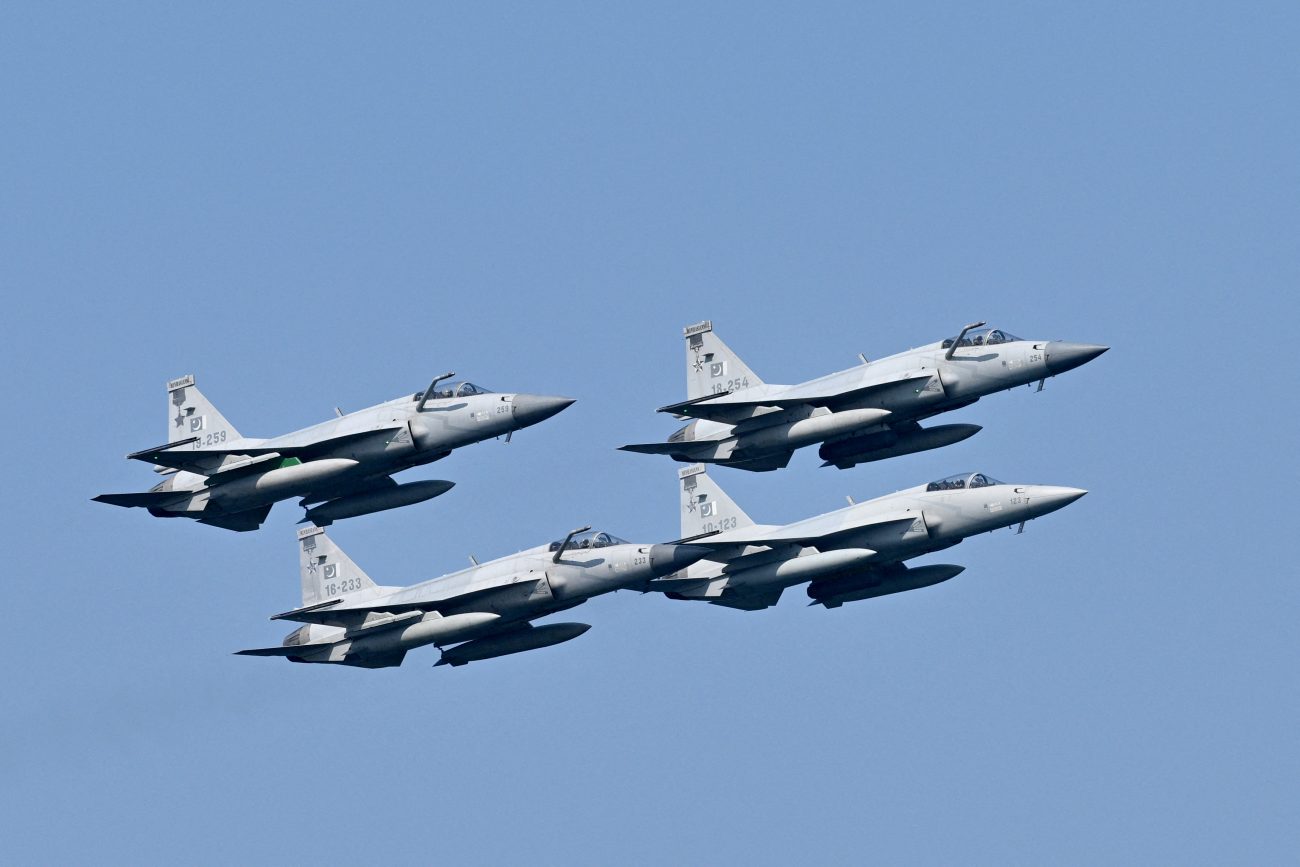
Due to its lower radar cross-section, the JF-17 Block III has better stealth characteristics. The aircraft also uses more composites and has better avionics. Block III incorporates an active electronically scanned array (AESA) radar, enhancing situational awareness and target tracking. It also features a helmet-mounted display (HMD) for improved pilot targeting and engagement.
The JF-17 Block III flaunts noticeable enhanced features like an integrated electronic warfare (EW) suite, Wide Angle Smart HUD, extra hard points, and Missile Approach Warning Systems (MAWS). The cost-effectiveness of JF-17 Thunder is its main advantage. It comes at roughly half the cost of the F-16 Fighting Falcon. While expected to be costlier, the Block III variant still offers significant advantages over its competitors.
Since its induction, the JF-17 has become a mainstay of the Pakistani Air Force and is now all set to bolster Baku’s air fleet, giving it an edge in the southern Caucasus
- Questions and Answers
- Opinion
- Motivational and Inspiring Story
- Technology
- Live and Let live
- Focus
- Geopolitics
- Military-Arms/Equipment
- Sicherheit
- Economy
- Beasts of Nations
- Machine Tools-The “Mother Industry”
- Art
- Causes
- Crafts
- Dance
- Drinks
- Film/Movie
- Fitness
- Food
- Spiele
- Gardening
- Health
- Startseite
- Literature
- Music
- Networking
- Andere
- Party
- Religion
- Shopping
- Sports
- Theater
- Health and Wellness
- News
- Culture

 Chinese
 English
 Arabic
 French
 Spanish
 Portuguese
 Turkish
 Dutch
Dutch
 Italiano
 Russian
 Romaian
 Portuguese (Brazil)
 Greek
Greek