

To what extent are European elites coordinating with U.S. and NATO security policies in the Pacific against Beijing?
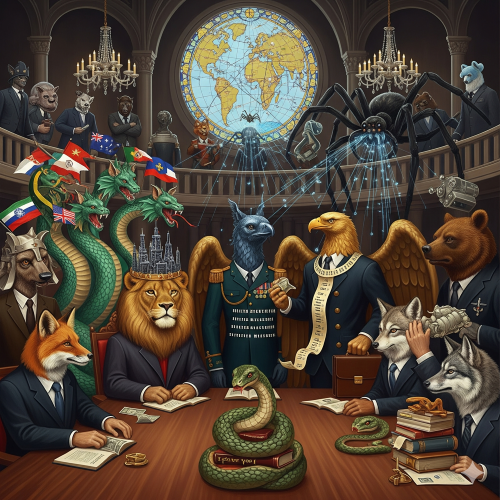
European elites are engaging in a complex, selective, and gradually increasing level of coordination with U.S. and NATO security policies in the Pacific against Beijing. This coordination represents a balancing act between the imperative of transatlantic solidarity and the long-term goal of European strategic autonomy.
While there is strong convergence on the diagnosis of the China challenge—seeing Beijing as a "systemic rival" whose actions threaten the rules-based order—there remains a significant divergence on the prescription, particularly on the military and economic approaches to the Indo-Pacific.
1. The Strong Foundation of Security Alignment
The most significant shift has been the formal recognition by European political and security elites that the security of the Euro-Atlantic and the Indo-Pacific theaters are "indivisible."
NATO's Strategic Shift
The 2022 NATO Strategic Concept was a landmark moment, explicitly stating that the People’s Republic of China’s (PRC) stated ambitions and coercive policies challenge NATO interests, security, and values.1 This institutional alignment with the U.S. view of China as a strategic challenge has been cemented through:
-
Partnerships with the IP4 (Indo-Pacific Four): Leaders from Australia, Japan, South Korea, and New Zealand—the cornerstone allies of the U.S. in the region—are now regular attendees at NATO summits (Madrid 2022, Vilnius 2023). This provides a formal, high-level mechanism for sharing intelligence and coordinating strategy regarding China's military buildup, cyber activities, and disinformation campaigns.
-
Focus on Emerging Technologies: Coordination within NATO focuses heavily on cybersecurity, supply chain resilience, and emerging and disruptive technologies (EDTs). The goal here is to align standards and controls (e.g., in 5G and semiconductors) to limit Beijing's access to crucial Western innovations, which is a core pillar of the U.S. strategy.
Individual European State Deployments
Key European powers have translated strategic rhetoric into concrete security action, primarily to signal their support for freedom of navigation and their commitment to regional partners, aligning with U.S. and regional security frameworks:
-
Naval Presence: The UK, France, and Germany have all deployed advanced naval assets, including aircraft carriers and frigates, to the Indo-Pacific. The UK's deployment of the HMS Queen Elizabeth Carrier Strike Group and regular French and German warship transits through the South China Sea directly reinforce the U.S. pushback against China's maritime territorial claims.
-
Interoperability: These European naval deployments routinely participate in military exercises with the U.S., Japan, Australia, and India. This increased interoperability is a direct military contribution to the U.S. alliance architecture, making any future coalition response in the region more feasible.
2. The Limits of Coordination: Strategic Autonomy and Economic Interests
Despite the security alignment, European coordination stops well short of fully embracing a U.S.-led "containment" or "decoupling" strategy. This resistance is rooted in Europe's unique geopolitical position and its commitment to Strategic Autonomy.
The Ambivalence of "Strategic Autonomy"
The concept of European Strategic Autonomy (ESA), most vocally championed by France's President Macron, aims to enable Europe to act as a "third geopolitical pole" independent of both the U.S. and China. This implies a significant difference in approach:
-
Risk of Entanglement: Many European elites fear that complete alignment with Washington's "America First" or transactional foreign policy could lead to them being dragged into a conflict over Taiwan that is not directly in core European security interests, or risk being marginalized by a potential future U.S. administration that prioritizes its own deals with Beijing.
-
Macron's Caution: The political firestorm following President Macron's 2023 comments—suggesting Europe should avoid being a "vassal" and not be drawn into the Taiwan issue—highlights the significant political fault line between the U.S. "pivot to Asia" and the desire of some European elites to maintain diplomatic distance on the most contentious regional issues.
Economic Interests vs. Security Risks
The most pronounced gap between U.S. and European elites lies in the economic relationship with China.
| Area | U.S. Elite Policy (Goal) | EU Elite Approach (Reality) |
| Trade & Investment | Aggressive decoupling and direct confrontation on trade practices. | Pursuit of "de-risking"—reducing critical dependencies (e.g., rare earths, solar panels) but actively maintaining trade and market access. |
| Technology Controls | Comprehensive export controls to choke China's access to advanced technologies (e.g., chips). | Selective, slower, and less comprehensive implementation of export controls, as seen in the debate over ASML chip-making equipment from the Netherlands. |
| Economic Coercion | Bilateral and multilateral retaliation against Chinese economic coercion. | Development of new EU defensive tools (like the Anti-Coercion Instrument) to protect member states (e.g., Lithuania), but maintaining direct dialogue. |
While the U.S. views economic action as a security tool, European elites are unwilling to sacrifice the massive economic gains from the Chinese market, preferring a more nuanced approach that labels China as simultaneously a "partner, competitor, and systemic rival."
3. The Transatlantic China Dialogue and Future Trajectory
European and U.S. coordination is actively managed through dedicated structures aimed at bridging these differences.
The EU-US Trade and Technology Council (TTC)
The TTC has become the primary venue for transatlantic coordination against China. It provides a formal, institutional framework for political elites to align policies on key issues like screening foreign investment, supply chain resilience, and technology standards. This demonstrates a deep-seated commitment to coordination at the bureaucratic and ministerial levels, even if political rhetoric sometimes diverges.
Future Volatility
The extent of future coordination hinges heavily on U.S. domestic politics. The experience of the Trump I administration, which often undercut European security interests (e.g., with unilateral tariffs or the sudden withdrawal from the Iran deal), created deep European distrust. European elites are preparing for a potential future U.S. administration that might once again question the value of the transatlantic security umbrella or demand European military resources be re-directed to Europe, making their strategic engagement in the Indo-Pacific less predictable and more complicated.
In summary, European elites are aligning with the U.S. and NATO on the principle that China's rise must be managed, and they are contributing militarily to that goal. However, their policy is not one of full containment, but of pragmatic balancing driven by a desire to secure their own economic interests and maintain a measure of strategic autonomy against what they perceive as the excesses of great power rivalry. This measured approach of "coordination with caution" defines the current state of the transatlantic security relationship in the Pacific.
- Questions and Answers
- Opinion
- Motivational and Inspiring Story
- Technology
- Live and Let live
- Focus
- Geopolitics
- Military-Arms/Equipment
- Segurança
- Economy
- Beasts of Nations
- Machine Tools-The “Mother Industry”
- Art
- Causes
- Crafts
- Dance
- Drinks
- Film/Movie
- Fitness
- Food
- Jogos
- Gardening
- Health
- Início
- Literature
- Music
- Networking
- Outro
- Party
- Religion
- Shopping
- Sports
- Theater
- Health and Wellness
- News
- Culture

 Chinese
 English
 Arabic
 French
 Spanish
 Portuguese
 Deutsch
 Turkish
 Dutch
Dutch
 Italiano
 Russian
 Romaian
 Greek
Greek