

Could Africa become a global supplier of specialized, affordable machine tools for other developing regions like Latin America and Southeast Asia?
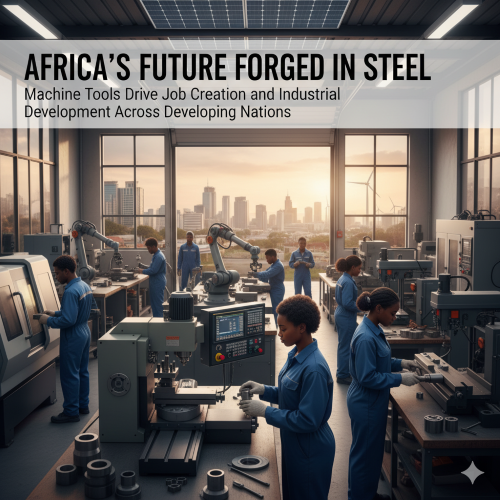
For centuries, Africa has been viewed primarily as a source of raw materials — minerals, oil, and agricultural commodities — rather than as a producer of advanced industrial goods.
However, a quiet revolution is possible if the continent strategically invests in one of the most foundational industrial sectors: machine tool manufacturing.
The question of whether Africa could become a global supplier of specialized, affordable machine tools for other developing regions — such as Latin America and Southeast Asia — may sound ambitious, but it is far from unrealistic.
In fact, this could be Africa’s pathway to establishing itself as a serious player in global manufacturing.
To understand how, we must examine the economic logic, technological opportunity, and geopolitical dynamics that could enable Africa to transition from importer to exporter of machine tools.
1. The Global Machine Tool Market and Africa’s Opportunity
The global machine tool market — valued at over $90 billion annually — is dominated by countries like Germany, Japan, China, Italy, South Korea, and Taiwan. Yet, the vast majority of machine tool designs cater to high-cost, high-precision manufacturing in advanced economies. This leaves a huge unmet need in the developing world for rugged, affordable, and easy-to-maintain machines suited to less stable environments — a niche Africa could fill.
Developing countries in Latin America, Southeast Asia, and parts of South Asia face similar challenges to Africa: unstable power, humid climates, and limited access to technical support. Imported European or Japanese tools are often too expensive and complex for small manufacturers in these regions. Meanwhile, cheaper Chinese tools, though accessible, can suffer from quality and durability issues.
Here lies Africa’s opening: by engineering machine tools adapted to tropical and low-infrastructure conditions, Africa can become a competitive exporter to fellow developing nations, offering both affordability and resilience — a “middle path” between high-end Western precision and low-cost Asian mass production.
2. Building on Shared Realities: The Global South Advantage
One of Africa’s greatest strengths is that it shares similar industrial conditions and development stages with regions like Southeast Asia and Latin America. This creates a natural alignment in product design and market needs.
For example:
-
Power reliability is an issue across large parts of the Global South. Machines designed in Africa with built-in voltage stabilizers, low-energy electronics, or hybrid power (solar/manual) systems would be directly useful elsewhere.
-
Climate adaptation (resistance to dust, humidity, and heat) is a shared need from Nigeria to Brazil, Kenya to Indonesia.
-
Low-cost repairability is crucial in all developing economies where spare parts supply chains are limited.
Instead of competing with advanced economies for ultra-precision or AI-driven robotic tools, Africa can specialize in mid-level, robust tools that prioritize resilience over luxury. In other words, Africa’s machine tools can be the Toyota Corolla of industrial hardware — reliable, affordable, and globally popular.
3. Learning from Global South Success Stories
To achieve this, Africa can take lessons from nations that built global reputations in niche manufacturing from humble beginnings:
-
India’s machine tool industry began by producing affordable, manually operated machines for domestic use in the 1960s. By the 2000s, Indian-made lathes and milling machines were being exported to over 50 countries across Africa and Latin America.
-
China focused on scaling production and lowering costs through government-backed industrial clusters. Today, Chinese firms dominate the entry-level machine tool market globally.
-
Brazil developed its own machine tool sector during import substitution in the 1970s, emphasizing local innovation for local needs.
Africa can combine these approaches — India’s localized engineering, China’s scale, and Brazil’s regional collaboration — to create a sustainable, export-ready ecosystem.
4. The Power of Regional Integration under AfCFTA
The African Continental Free Trade Area (AfCFTA) provides a historic opportunity to treat Africa as one unified manufacturing base rather than 54 fragmented markets. Regional specialization could make machine tool production highly efficient:
-
North Africa (Egypt, Morocco, Tunisia) could focus on precision engineering and CNC production.
-
West Africa (Nigeria, Ghana) could produce medium-scale industrial machines and agricultural implements.
-
East Africa (Kenya, Ethiopia, Tanzania) could focus on renewable energy-related machinery and lighter tools.
-
Southern Africa (South Africa, Zimbabwe, Zambia) could specialize in mining, construction, and heavy fabrication tools.
By leveraging these complementary strengths, Africa could establish a network of regional machine tool hubs, each serving local industries and collectively exporting globally.
Once Africa achieves internal industrial capacity, exporting to developing markets will become natural — supported by Afreximbank, African Development Bank (AfDB), and Pan-African R&D collaborations.
5. Specialization: The Key to Global Competitiveness
Africa doesn’t need to produce every type of machine tool. Instead, it should specialize in areas where it holds comparative advantages, such as:
-
Agricultural machine tools: For producing and repairing farm equipment tailored to smallholder farmers — useful across Africa, Asia, and Latin America.
-
Construction tools: Concrete mixers, brick presses, and rebar benders designed for tropical and developing country infrastructure.
-
Mining and extractive tools: Simple but powerful machines for mineral cutting, grinding, and drilling.
-
Renewable energy components: Tools for fabricating solar frames, turbine components, and biogas units.
-
Affordable CNC retrofits: Low-cost kits to convert manual lathes or mills into semi-automated systems — a game changer for small industries.
By focusing on specialized, affordable, and durable designs, African manufacturers can export not just machines, but also the engineering philosophy of practicality and resilience that resonates with other emerging markets.
6. Building Trust through Quality and Certification
To become a trusted exporter, Africa must build credibility. This requires the creation of African quality standards for machine tools that align with international benchmarks such as ISO or DIN.
Institutions like the African Organization for Standardization (ARSO) and the Pan-African Machine Tool Institute (if established) can coordinate testing, certification, and R&D collaboration.
Additionally, trade fairs and partnerships — for example, Africa-Latin America Technology Exchange Summits — could help promote African machinery to foreign buyers.
If African tools consistently perform well in rugged conditions, they could develop a brand identity similar to Japanese products in the 1970s — once dismissed as “cheap,” later celebrated as world-class.
7. Leveraging Technology for Global Competitiveness
Modern digital tools can enable Africa to bypass old barriers. For example:
-
3D printing and CNC design software can allow rapid prototyping of customized machines for different climates or industries.
-
Open-source control systems can lower software costs and attract global innovation communities.
-
Smart manufacturing clusters can integrate robotics, sensors, and automation gradually, improving precision without high costs.
-
Digital marketing and e-commerce platforms can allow African machine tool makers to reach clients in Latin America or Asia directly.
These innovations make it possible for small African manufacturers to think globally from day one, exporting through digital supply chains.
8. Financing and Policy Support
African governments must treat machine tool development as a strategic export industry, not just a technical project. Policy frameworks could include:
-
Export incentives and low-interest loans for machine tool exporters.
-
Joint ventures with friendly nations (India, Brazil, China) for technology transfer.
-
Tax exemptions on local R&D and equipment import for prototyping.
-
Regional export insurance and credit facilities through Afreximbank or ECOWAS Bank for Investment and Development (EBID).
Development banks and sovereign wealth funds can invest in industrial clusters that combine foundries, assembly lines, and training centers to boost export readiness.
9. Building a “Made-in-Africa” Brand
For Africa to become a global supplier, it must build a recognizable industrial brand rooted in values like durability, practicality, and inclusivity. African machine tools could be marketed as:
“Built for the real world — tough, simple, and smart.”
This message would resonate deeply with industries across the developing world that face similar realities. Branding matters as much as engineering — a strong African industrial identity can reshape global perceptions.
10. The Bigger Picture: South-South Industrial Solidarity
If Africa becomes an exporter of machine tools to the Global South, it wouldn’t just be a commercial success — it would symbolize South-South industrial solidarity. Instead of competing for aid or cheap labor, developing regions could trade knowledge, tools, and innovation, creating a new global industrial order that challenges Western monopolies on technology.
An African machine tool hub could support local manufacturing in Peru, Bangladesh, Vietnam, or Bolivia, just as Japan’s tools once powered industrialization across Asia. This would represent a historic reversal of dependency — transforming Africa from a consumer of foreign machines into a producer for global peers.
+++++++++++++++++++++++++++
Africa has the potential to become a global supplier of specialized, affordable machine tools — not by imitating the West, but by innovating for the realities of the Global South.
Through regional integration (AfCFTA), targeted R&D, and smart specialization, African industries can design tools that thrive under the same conditions faced by billions in Asia and Latin America. These tools — resilient, repairable, and resource-efficient — could become Africa’s most valuable export after decades of raw material dependency.
The machine tool is called the “mother of all industries.” If Africa masters it, the continent could not only industrialize itself but also help industrialize the rest of the developing world — becoming a cornerstone of the next global manufacturing revolution driven by the Global South.
- Questions and Answers
- Opinion
- Motivational and Inspiring Story
- Technology
- Live and Let live
- Focus
- Geopolitics
- Military-Arms/Equipment
- Security
- Economy
- Beasts of Nations
- Machine Tools-The “Mother Industry”
- Art
- Causes
- Crafts
- Dance
- Drinks
- Film/Movie
- Fitness
- Food
- Games
- Gardening
- Health
- Home
- Literature
- Music
- Networking
- Other
- Party
- Religion
- Shopping
- Sports
- Theater
- Health and Wellness
- News
- Culture

 Chinese
 Arabic
 French
 Spanish
 Portuguese
 Deutsch
 Turkish
 Dutch
Dutch
 Italiano
 Russian
 Romaian
 Portuguese (Brazil)
 Greek
Greek