

F-35 vs J-20: End of American Air Supremacy As China Set To Deploy As Many As 1300 Stealth Fighters By 2030?

Operation Absolute Resolve in Venezuela and Operation Rising Lion and Midnight Hammer in Iran have proven one thing – it’s decisive air power that wins wars and wins them fast.
On the other hand, the Russia-Ukraine war will soon enter its fifth year precisely because Moscow failed to establish air superiority over Kyiv.
Air power is key to winning wars and power projection. However, amid a rapidly changing geopolitical and technological landscape, can Washington be sure of its edge in air power over its adversaries, primarily Russia and China?
According to a new research paper by the UK-based think tank Royal United Services Institute (RUSI), the traditional US superiority in air power will be increasingly threatened by China and Russia by 2030.
At the outset, the research paper says that both Russian and Chinese air capabilities have evolved significantly in the last five years.
“In 2025, Chinese air power in particular poses a fundamentally different level of threat to traditional US dominance in the air domain than it did in 2020,” it said, adding that even Russian air power represents a greater threat to Western air power capabilities in Europe.
It emphasizes that while Russia’s developments represent an incremental but broad enhancement, largely informed by its ongoing war in Ukraine, China’s progress poses a “fundamentally different level of threat” that could revolutionize air domain contests, particularly in the Indo-Pacific.
Furthermore, the paper warns that by 2030, the effectiveness of US stealth aircraft, such as the F-22 and F-35, will be limited in penetrating contested airspace.
However, the biggest threat to the US’s dominance in air power is the PLA Air Force’s (PLAAF) rapidly expanding and modernizing fleet, including stealth fighter jets.
China’s Rapidly Expanding & Modernizing Fleet
Since 2020, the PLAAF has dramatically scaled up production of advanced platforms.
The PLAAF had a fleet of 90-100 J-16 heavy fighters in 2020; by 2025, this fleet had grown to 450 fighter jets. Additionally, the production rate of the J-16 has almost doubled over the last five years.
In 2020, China was producing nearly 40 J-16 jets in a year; in 2025, its annual production rate for the J-16 had increased to 80-100 fighter jets.
According to RUSI’s estimates, by 2030, China could have a fleet of 900 J-16s.
China could also field a fleet of nearly 800 J-10C fighter jets, a very capable platform with AESA radar and advanced sensors, which was combat-tested against India’s fleet of modern Russian and French fighter jets in May 2025.
China’s capacity expansion in producing the stealth J-20 fighter jets is even more impressive. The PLAAF had a fleet of 40-50 J-20 jets in 2020, which has grown to 120 fighter jets by 2025.

The annual production rate of the J-20 has increased from 20 fighter jets in 2020 to 120 in 2025.
By 2030, China could deploy as many as 1,000 J-20 heavy stealth fighter jets.
Notably, Lockheed Martin delivered a record 191 F-35 fighter jets in 2025. However, these 191 F-35 fighter jets were produced for 19 countries, whereas the 120 J-20 jets were produced solely for the PLAAF.
Additionally, China’s second stealth fighter jet, the J-35A, has also entered serial production, and the PLAAF can also field a substantial number of these jets by 2030.
There is also a noticeable trend towards heavy fighters in general, with J-16s and J-20s being used to re-equip units that previously were operating not only J-11 and Su-27/30 Flanker heavy fighters, but also some J-7 light and J-8 medium fighters.
China is also adding electronic warfare variants such as the J-16D and the J-15DT/DH at a frantic pace.
Beijing is also testing two sixth-generation platforms, tentatively named the tri-engine J-36 and the J-50.
According to the RUSI paper, “Both are clearly designed to incorporate advanced broadband stealth characteristics and optimised for air-to-air missions at high altitudes and speeds. The J-36 in particular will probably have an extremely impressive range on internal fuel and a huge internal weapons bay that would be able to hold not only significant numbers of PL-15 and PL-16 long-range air-to-air missiles, but also probably the larger PL-17 missile, which is currently only carried externally by the J-16 Flanker.”
By 2030, China could field a significant number of these aircraft, alongwith uncrewed combat aerial vehicles (UCAVs) and collaborative combat aircraft (CCA).
This quantitative surge, combined with qualitative upgrades, threatens to overwhelm US forces in terms of numbers and capabilities, challenging air superiority in contested zones.
Advanced Missiles And Sensors
China has also fielded advanced and very long-range missiles. China’s air-to-air missiles, such as the PL-15, PL-16, and PL-17, outrange Western equivalents, such as AIM-120.
These missiles also feature active electronically scanned array (AESA) seekers for high-speed, precision engagements.
The combat performance of the PL-15 has already proven during the May 2025 India-Pakistan clash.
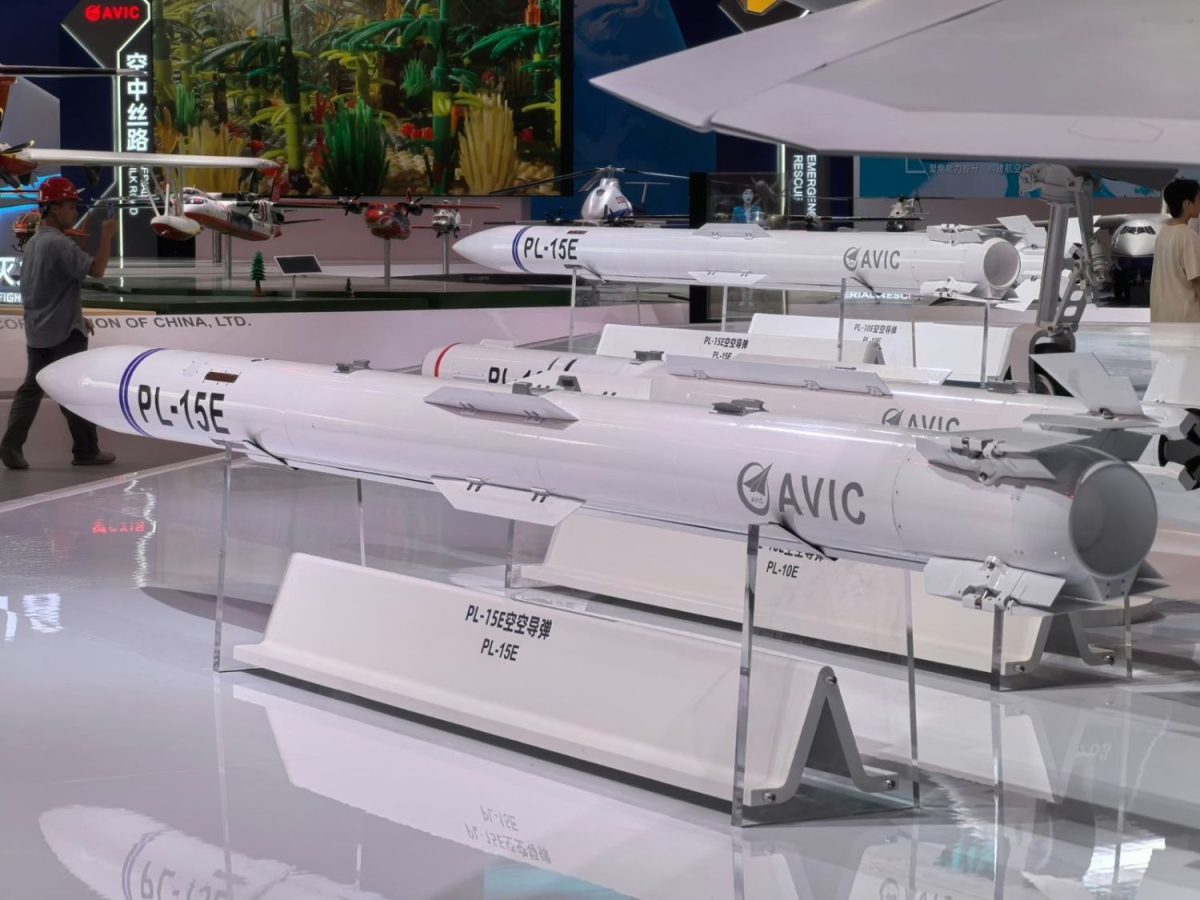
According to Pakistani claims, the PL-15 shot down an Indian fighter jet from a distance of nearly 200 km, scoring the longest air-to-air kill in aerial combat history.
China has also fielded various air defense systems, including HQ-9B/C, HQ-22, HQ-19/26, and HQ-16.
There are also indications that the PLA is actively funding the development and testing of ultra-long-range SAM systems with ranges of 2000 km or even more, which operate according to fundamentally different principles from traditional SAMs.
These systems appear to combine a boost stage of a ballistic missile with a payload section that can launch air-to-air missiles or a manoeuvrable kill vehicle that would intercept aircraft in their terminal phase of flight.
These systems would create dense anti-access/area-denial (A2/AD) bubbles.
Complimented by KJ-500 airborne early warning and control (AEW&C) aircraft and orbital intelligence, surveillance, and reconnaissance (ISR) assets, these systems would enable robust kill chains that could target US high-value assets at ranges exceeding 1,000 km.
Additionally, China has shifted to AESA radars as the primary sensors of all the fighter types still in production – namely, the J-10C, J-16, J-20, and now the J-35.
Training And Integration
Enhanced pilot training through international competitions, hiring Western ex-aircrew, and complex exercises has improved PLAAF proficiency.
Simultaneously, China is integrating unmanned combat aerial vehicles (UCAVs) and collaborative combat aircraft (CCAs), alongside electronic attack platforms, such as the Y-9LG.
These enhanced combat capabilities of China mean that the traditional air superiority the Western nations enjoyed over Beijing might have eroded.
“The PLA now fields a range of capabilities that can threaten US Air Force aerial refuelling tankers, US Navy carrier groups, and forward air bases at 1000 km or more. These include thousands of long-range ground-based, air-launched,d and maritime ballistic and cruise missiles, as well as long-range ground-based SAMs and long-range air-to-air weapons carried by hundreds of advanced fifth-generation fighters.”
In the future, the strategy of the US joint force and its Indo-Pacific allies would be to gain and leverage temporary air superiority at key points in any clash with the PLA.
The US-led Western forces may still be able to win localised and temporary windows of air superiority in a potential conflict by leveraging greater operational experience; careful use of fifth-generation F-22s and F-35s alongside legacy assets; high-end training and exercise programmes such as Red Flag and Bamboo Eagle; new weapons and platforms like the AIM-260, B-21, and F-47; and rapid development and fielding of suitable CCAs.
However, the research paper warns, current Chinese capability growth is sufficiently impressive and rapid that the traditional Western airpower edge is no longer guaranteed in the Indo-Pacific.
- Questions and Answers
- Opinion
- Motivational and Inspiring Story
- Technology
- Live and Let live
- Focus
- Geopolitics
- Military-Arms/Equipment
- Segurança
- Economy
- Beasts of Nations
- Machine Tools-The “Mother Industry”
- Art
- Causes
- Crafts
- Dance
- Drinks
- Film/Movie
- Fitness
- Food
- Jogos
- Gardening
- Health
- Início
- Literature
- Music
- Networking
- Outro
- Party
- Religion
- Shopping
- Sports
- Theater
- Health and Wellness
- News
- Culture

 Chinese
 English
 Arabic
 French
 Spanish
 Portuguese
 Deutsch
 Turkish
 Dutch
Dutch
 Italiano
 Russian
 Romaian
 Greek
Greek