

Should African countries collaborate regionally (through the African Union or AfCFTA) to build a continental machine tool industry?
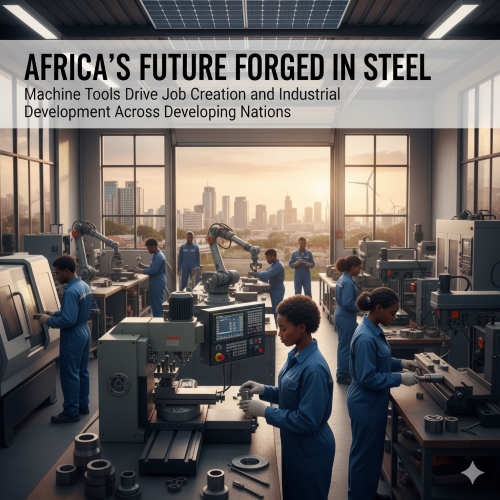
Should African Countries Collaborate Regionally to Build a Continental Machine Tool Industry?
The African continent stands at a historic crossroads. On one hand, it is blessed with abundant natural resources, a growing population projected to reach 2.5 billion by 2050, and a rapidly expanding consumer market. On the other hand, it continues to lag behind in manufacturing capacity, relying heavily on imports of finished goods while exporting raw materials with little value addition.
A critical bottleneck in this equation is the absence of a strong machine tool industry. Machine tools—lathes, milling machines, presses, CNC systems, and robotics—form the backbone of industrialization. Without them, no country can build the factories that produce cars, tractors, construction equipment, energy systems, or even simple household appliances.
The question, then, is whether African nations should build such an industry independently or collaborate regionally under platforms like the African Union (AU) and the African Continental Free Trade Area (AfCFTA).
The answer leans strongly toward regional collaboration, as this approach could accelerate industrial development, spread costs and risks, and create a continental market for machinery.
Why a Machine Tool Industry is Critical for Africa
Machine tools are often called the “mother industry” because they manufacture the equipment that makes all other products possible. Without machine tools, a nation must import most of its industrial machinery, which traps it in a cycle of dependency. For Africa, this means:
-
Loss of value addition: Africa exports raw minerals and agricultural products but imports the machinery needed to process them into high-value goods.
-
Drain on foreign exchange: Billions of dollars are spent annually on importing industrial machinery.
-
Missed job opportunities: Every imported machine represents lost opportunities for engineers, technicians, and factory workers.
-
Weak industrial sovereignty: Without control over machine tool production, Africa cannot fully control its manufacturing destiny.
To break this cycle, Africa needs not just isolated national initiatives but a continental-scale effort.
The Case for Regional Collaboration
1. Economies of Scale
Building a machine tool industry is expensive. It requires advanced research facilities, highly skilled labor, precision metallurgy, and large domestic demand. Most individual African countries lack the scale to justify these investments. A regional approach could pool demand across the continent’s 1.4 billion people and its expanding industrial base.
-
Example: Rather than Nigeria, Kenya, or Egypt each attempting to independently build CNC production facilities, a shared regional center could serve the entire African market.
2. Shared Research and Development (R&D)
Machine tools demand continuous innovation—whether in precision, automation, or digital integration. Regional R&D hubs under AU or AfCFTA frameworks could harness expertise from across Africa’s universities and research institutes. Collaborative R&D reduces duplication of effort and accelerates progress.
-
Example: The Pan-African University or African Centers of Excellence could establish specialized machine tool research divisions.
3. Coordinated Industrial Strategy
If each country tries to build its own machine tool sector, duplication, inefficiency, and unhealthy competition are likely. A continental framework allows specialization.
-
South Africa could focus on mining machinery and heavy machine tools.
-
Egypt could specialize in CNC and precision engineering.
-
Nigeria could focus on agricultural machinery tools.
-
Kenya and Ethiopia could take leadership in renewable energy machinery.
This division of labor creates a complementary ecosystem instead of fragmented, weak national industries.
4. Stronger Bargaining Power
Collectively, African countries could negotiate better terms with global technology providers from Germany, Japan, China, or South Korea. Regional collaboration ensures that partnerships, technology transfers, and licensing agreements happen on Africa’s terms, not through unequal bilateral deals.
5. Building a Continental Market
Machine tools require a steady, large-scale market to remain viable. AfCFTA removes tariffs and trade barriers between African nations, ensuring that a company in Ghana can sell machinery to Tanzania or Senegal with minimal friction. This creates the demand base necessary for competitive production.
Challenges of Regional Collaboration
1. Political Will and Coordination
African countries often struggle with fragmented policies and political rivalries. Building a joint industry requires strong AU or AfCFTA leadership to overcome national egos and ensure equitable benefits.
2. Infrastructure Gaps
Many African nations lack adequate transport, power, and digital infrastructure. Regional integration must therefore go hand-in-hand with infrastructure investments to move machinery and components across borders.
3. Skills Shortages
Africa still suffers from shortages of skilled engineers, machinists, and technicians. Regional centers for vocational training and technical universities must be expanded to supply the needed workforce.
4. Funding
Building machine tool plants and R&D centers requires billions in investment. Africa must mobilize resources through development banks (AfDB), sovereign wealth funds, and partnerships with private investors.
Lessons from Other Regions
Europe: Coordinated Industrial Policies
Germany dominates the machine tool industry, but it is deeply integrated with the EU market. Smaller EU nations benefit by supplying parts, technology, or specialized machinery. Africa can emulate this model through AfCFTA.
Asia: Regional Ecosystems
Japan, South Korea, and China did not rise in isolation. Their industries were supported by regional demand, global integration, and specialization. China, for example, invested massively in machine tools as part of its Five-Year Plans, while South Korea focused on niche high-precision tools. Africa could adopt a similar collective trajectory.
Long-Term Benefits of a Continental Machine Tool Industry
-
Reduced Import Dependency: Billions saved annually on machinery imports.
-
Job Creation: Direct employment in factories and indirect jobs in supply chains, training, and maintenance.
-
Youth Empowerment: A machine tool economy stimulates demand for engineers, machinists, programmers, and technicians.
-
Technological Sovereignty: Africa gains control over its own industrialization path.
-
Diversified Industries: From automotive to renewable energy, construction to agriculture, local machine tool production underpins all sectors.
-
Pan-African Unity in Practice: A continental machine tool sector makes AfCFTA more than a trade deal—it becomes an engine for real industrial cooperation.
Conclusion
Africa’s industrialization cannot succeed without machine tools. But building this industry is too costly and complex for individual nations acting alone. A continental approach—anchored in AU and AfCFTA frameworks—offers the best chance for Africa to catch up with global machine tool giants. Regional collaboration would pool demand, share costs, boost bargaining power, and foster complementary specialization across the continent.
By working together, African nations could transform the machine tool sector into the backbone of continental industrial independence. This would not only reduce dependence on foreign imports but also unleash millions of jobs, empower youth with technical skills, and position Africa as a serious player in global manufacturing.
Africa should collaborate regionally to build a continental machine tool industry. The alternative—fragmented, import-dependent development—would only perpetuate underdevelopment and dependency.
_________________________________________
www.ubuntusafa.com
“Industrial wisdom is not about who finds the minerals, but who transforms them.”
- Questions and Answers
- Opinion
- Motivational and Inspiring Story
- Technology
- Live and Let live
- Focus
- Geopolitics
- Military-Arms/Equipment
- Security
- Economy
- Beasts of Nations
- Machine Tools-The “Mother Industry”
- Art
- Causes
- Crafts
- Dance
- Drinks
- Film/Movie
- Fitness
- Food
- Games
- Gardening
- Health
- Home
- Literature
- Music
- Networking
- Other
- Party
- Religion
- Shopping
- Sports
- Theater
- Health and Wellness
- News
- Culture

 Chinese
 Arabic
 French
 Spanish
 Portuguese
 Deutsch
 Turkish
 Dutch
Dutch
 Italiano
 Russian
 Romaian
 Portuguese (Brazil)
 Greek
Greek