
The Dolphins Who Whispered in the Deep Council
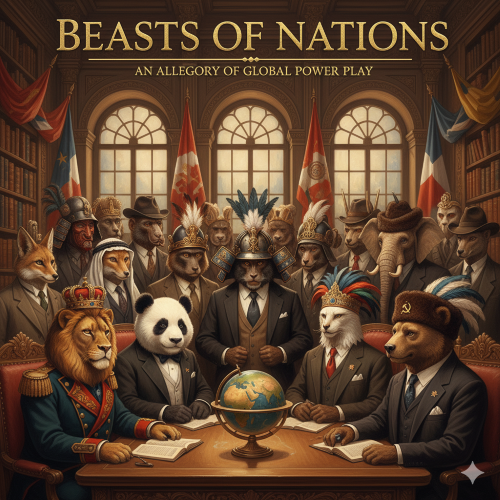
The sapphire depths of the open ocean were a realm of silent giants, but beneath the surface noise of the great currents, there existed a subtle, complex network of sound. This was the domain of the Dolphins, creatures of peerless intelligence, swift communication, and sophisticated social structure. They were the architects of underwater consensus, the swift messengers, and the perpetual, cheerful observers of the world's aquatic affairs.
These were the Dolphins Who Whispered in the Deep Council. They symbolized rapid communication networks, technological innovators, and agile diplomatic operators—entities that focused on speed, information flow, and forming coalitions. They didn't possess the brute force of the Sharks or the immense scale of the Whales; their power lay in their ability to connect, share information instantly, and mobilize collective opinion with persuasive subtlety.
Their leader was Echo, a sleek, scarred female whose signature whistles and clicks were understood across hundreds of miles of open sea. The Deep Council itself was not a physical location, but a continuously shifting, decentralized conversation—a constant, instantaneous exchange of data and perspectives that allowed the Dolphins to react to global events faster than any other creature.
The Network of Consensus
The Dolphins had a unique relationship with the other powers. They were too swift and intelligent to be easily predated by the Sharks, whom they viewed as necessary, albeit blunt, custodians of the sea lanes. They respected the massive, slow authority of the Whales (resource-rich maritime nations), acting as their eyes and ears, often guiding their massive convoys through treacherous waters.
They were the first to know about any significant change. A shift in the temperature of a key current, a new, aggressive patrol pattern from the Sharks, or a rare gathering of the terrestrial Elephants near the coast—all were immediately translated into clicks and whistles, analyzed, and disseminated throughout the Council.
Their methods were built on shared trust and mutual benefit. They didn't seek to control resources directly; instead, they sought to control the information about resources, ensuring they were always at the center of any major transaction or negotiation. Their role was that of the indispensable intermediary, the one who knew the location of the best fishing grounds, the safest migratory routes, and the clearest channels for trade.
The Threat of the Monolith
Lately, the Council was preoccupied with a pressing threat: Leviathan, the most powerful of the Sharks, was becoming too entrenched. His perpetual circling around the vital coastal trading choke points was turning into an extractive monopoly, making him slow, predictable, but immensely powerful. The price of passage through Leviathan’s controlled zones had become exorbitant, stifling the trade of even the most necessary commodities.
The Dolphins couldn't challenge Leviathan directly. His power was physical, direct, and overwhelming. To send a single, large convoy against him would be suicidal. They knew that a military confrontation would result in massive, self-defeating losses, and the Vultures (global finance), who were always circling, would only profit from the ensuing chaos.
Echo's strategy, debated and refined instantly across the Deep Council, was to bypass the monolith—not physically, but strategically.
"If he controls the short path," Echo signaled in a complex series of rapid clicks, "we must create a new, faster, safer long path."
The traditional trade route was a straight shot along the coast, a bottleneck that played directly into Leviathan's hands. The Dolphins proposed and executed a revolutionary new corridor: a deep-ocean, circuitous route that utilized little-known currents and complex, abyssal geography, routes the lumbering Sharks considered too unprofitable or difficult to patrol.
Weaving the New Trade Route
The operation was a masterwork of coordination. First, the Dolphins pooled their advanced mapping data, leveraging their superior sonar technology to map the deep currents with unprecedented accuracy. Then, they formed a coalition.
Echo first approached the Whales. She presented the data, arguing that Leviathan’s monopoly was ultimately draining their mutual resource base. The Whales, whose interests lay in long-term stability and maximizing their vast resource export, agreed to provide a few massive, slow-moving ships as "anchor points" for the new route—a show of legitimacy and stability.
Next, Echo signaled the Dolphins of the Pacific Current, a vast, neutral coalition of intelligent marine life, convincing them that the new route offered them greater security and prosperity than the old, Shark-dominated one. They agreed to contribute their own sophisticated communication relays along the deep-sea corridor.
The new route was invisible to the terrestrial Crows' aerial surveillance and too deep and complex for Leviathan's simple, powerful patrols. It required continuous, real-time communication, constant navigation adjustments, and complex protocols—all capabilities exclusive to the Dolphins and their allies.
When the first few trade convoys—small, fast-moving groups of Dolphins carrying high-value, low-volume goods—successfully and safely completed the deep-ocean route, the impact was immediate. The price of goods in the coastal zones began to drop dramatically. The very market Leviathan controlled was being undermined, not by attack, but by efficiency.
Leviathan, initially dismissive, grew furious. He sent his powerful, fastest hunter Sharks to patrol the deep ocean, but they were quickly frustrated. They couldn't keep up with the Dolphins' speed, and the complexity of the abyssal currents confused their simpler navigation methods. They returned exhausted, reporting only vague, shifting traces of their prey.
Echo, maintaining the communication flow from the safety of the new route, sent a final, complex whistle to Leviathan—not a threat, but a statement of new reality: "The ocean is vast. You control the shortest path, but we control the fastest network."
The Dolphins had not destroyed the Shark, but they had effectively circumvented his power, transforming a physical, unavoidable bottleneck into an obsolete, overpriced option. They continued their ceaseless communication, weaving new protocols, establishing new alliances, and confirming that in the modern world, the true dominance belongs not to the one with the biggest teeth, but to the one who controls the flow of information and the speed of the network.
- Questions and Answers
- Opinion
- Motivational and Inspiring Story
- Technology
- Live and Let live
- Focus
- Geopolitics
- Military-Arms/Equipment
- Sicurezza
- Economy
- Beasts of Nations
- Machine Tools-The “Mother Industry”
- Art
- Causes
- Crafts
- Dance
- Drinks
- Film/Movie
- Fitness
- Food
- Giochi
- Gardening
- Health
- Home
- Literature
- Music
- Networking
- Altre informazioni
- Party
- Religion
- Shopping
- Sports
- Theater
- Health and Wellness
- News
- Culture

 Chinese
 English
 Arabic
 French
 Spanish
 Portuguese
 Deutsch
 Turkish
 Dutch
Dutch
 Russian
 Romaian
 Portuguese (Brazil)
 Greek
Greek