

EMOTION REGULATION- Where Are You on the Emotional Pendulum? The pendulum represents emotional swings from over- to under-regulated. Reviewed by Davia Sills
KEY POINTS-
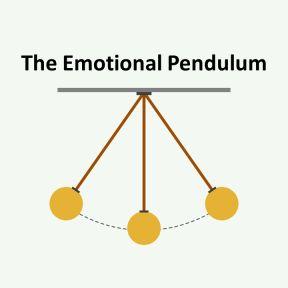
- Imagine an emotional pendulum that swings from over-regulated to centered to under-regulated.
- The over-regulated side represents being cut off from one's emotional life.
- The under-regulated side signifies being overwhelmed and acting out impulsively.
- The center is the sweet spot of being aware and attuned, while also adaptively regulating one's emotions.
This blog was co-authored with Marcia Gralha, M.A.
Do you remember the last time you did or said something impulsive that you later regretted? Maybe you were feeling angry, stressed, anxious, or demoralized. What about the last time you tried to suppress a negative feeling, only to have it come back stronger? You may have felt frustrated, disappointed, or defeated about how you managed your feelings. How did you relate to those secondary reactions about your feelings?
In this blog, we share with you the idea of an Emotional Pendulum and invite you to consider where—and when—you are on it. We frame it as a pendulum because this is a dynamic process. There are likely times when you handle emotions well, which, as will be clear, means you are “centered” on the pendulum. And there will be times when you are swinging to one side or the other in suboptimal ways.

As shown, swinging to the left side represents the over-regulated, under-expressed emotional response. This can look like a subtle form of repression where you are barely aware of the feeling before your defenses kick in, and you evade it. At the most extreme, it is a full-fledged denial of a feeling that is obviously present. This is called the over-regulated zone because it often arises from a misguided attempt to control the feeling (e.g., “I should not feel this way”; “This feeling will only cause problems”).
Over-regulation often results in individuals feeling confused and disconnected from their feelings. It also is associated with something called a “dismissive” relational style. This is where an individual has trouble talking about their feelings or expressing vulnerability or intimacy. The summary point for this part of the pendulum is that feelings are scary, and consequently, they are repressed, suppressed, and avoided.
Swinging to the right is the under-regulated, over-expressed response. This is when we are overwhelmed by a feeling or over-express it, often in an impulsive manner. This looks like rapid, explosive, or harsh reactions against oneself, others, or the world, like lashing out when you are angry at someone.
This pole is generally characterized by mindless reactivity versus mindful responsivity. It represents the times when emotions flood the system, and you can’t or don’t want to control the impulses that flow from the emotions. It is often associated with an anxious or dependent relational style, where the individual is flooded with feelings of dependency, frustration, or helplessness and is constantly experiencing and expressing guilt, shame, and vulnerability.
The center of the pendulum represents what is called the emotional sweet spot. The center here does not mean the absence of energy but rather alignment. It is when you are attuned to your emotions and can bring them on to the stage of awareness with acceptance while also maturely and adaptively regulating the spreading activation and impulses that come with the feelings. It is generally associated with more secure relational styles.
Emotions and Emotional Regulation
You can use the pendulum to frame where you are as you experience strong emotions. To do so effectively, it is helpful to understand the nature of emotions and emotional regulation. Emotions are responses to events that have a “valence”; they communicate something about your needs and goals, orient you to see the world a particular way, and energize motion toward a goal. They also charge the body in particular ways. Put in simple terms regarding our negative emotions, when things go wrong, we get a peak of active emotional energy, such as fear, anxiety, or anger, that motivates us to handle the situation at hand. In other words, we get an emotional impulse.
Emotion regulation has become a trendy topic in the media, and being in control of one’s feelings is a goal shared by many. In practice, effective emotion regulation is a journey with no finish line, filled with tests as novel stressors inevitably arise. As we tread our path in life, we can gain practice at working through those stressors and grow more confident in our ability to “pass the tests.” Thankfully, a number of emotion-regulation strategies are available for us to add to our toolbox.
But what is the core message of these various skills and strategies? What is at the heart of effectively regulating one’s emotions? We believe it is the search for the emotional sweet spot.
The “middle path” of emotion regulation requires the mature understanding that tolerating pain and discomfort is part of adult life. In the long term, it is the space in which we can feel more efficient, competent, and reliable in dealing with our emotions adaptively. This wise response to strong emotions is focused on what can be learned or gained from the emotional experience rather than on relieving oneself from the discomfort of it. The emotional sweet spot is not “sweet” because it necessarily feels good but because it brings about the most adaptive outcome for you and those around you. Further, as it is exercised over time, it brings about a “sweet” sense of peace and self-efficacy.
Finding this emotional sweet spot requires an initial inhibition of the natural behavioral impulses of strong emotions. This can look like taking a second to take a deep breath before saying something hurtful to oneself or to others or before immediately trying to do something to fix a crisis. Centering on the sweet spot also requires courage to face a distressing negative feeling with assertiveness and ownership of one’s emotional reactions. This takes courage because oftentimes, we may dislike our own reactions, making avoidant responses very attractive as a form of regaining a coherent view of oneself.
Locating your emotional sweet spot involves swaying between a space of awareness and attunement to the emotion that wants to be expressed and adaptive regulation of the pain and discomfort that the emotion brings. As described in this blog, the sweet spot is more easily found when one adopts a “CALM” attitude: one of curiosity, acceptance, loving compassion, and motivation toward valued states. Helpful questions to ask oneself when searching for the emotional sweet spot are:
- How can I accurately label this feeling?
- What triggered it? Why am I feeling this now?
- What is this feeling trying to communicate or signal? What is its function?
- Is this feeling congruent with my reality now? Does it make sense, given my current context?
- Is this feeling helpful? Is it aligned with my valued states of being?
- What do I want to do about this feeling in alignment with my values?
Accepting and holding one’s emotions with awareness, attunement, and adaptive regulation is not easy, but, as revealed in many studies, it is one of the keys to living a wise life. As such, we urge you to reflect on where you are on the emotional pendulum and embark on a journey to find ways to remain centered around the emotional sweet spot.
- Questions and Answers
- Opinion
- Motivational and Inspiring Story
- Technology
- Live and Let live
- Focus
- Geopolitics
- Military-Arms/Equipment
- Segurança
- Economy
- Beasts of Nations
- Machine Tools-The “Mother Industry”
- Art
- Causes
- Crafts
- Dance
- Drinks
- Film/Movie
- Fitness
- Food
- Jogos
- Gardening
- Health
- Início
- Literature
- Music
- Networking
- Outro
- Party
- Religion
- Shopping
- Sports
- Theater
- Health and Wellness
- News
- Culture

 Chinese
 English
 Arabic
 French
 Spanish
 Portuguese
 Deutsch
 Turkish
 Dutch
Dutch
 Italiano
 Russian
 Romaian
 Greek
Greek