
COGNITION- A New Illusion of Relative Height. In the new Box-Circle illusion, horizontal boxes affect verticality judgments. Reviewed by Davia Sills

KEY POINTS-
- There are many visual illusions where vertical context affects judgments of height and size.
- In the new Box-Circle illusion, horizontal context affects judgments of vertical alignment.
- Horizontally variable boxes cause vertically aligned dots to appear misaligned.
Perception researchers have discovered many illusions where context affects perceived size and distance. A great example of this is the Ponzo illusion (reviewed in an earlier blog post).
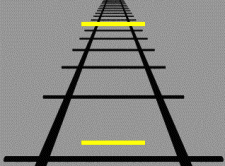
Here, the convergence of the "railroad tracks" creates a three-dimensional percept that makes the upper yellow line appear farther away than the lower yellow line. In turn, the illusion of depth leads to a distortion of size. We perceive the upper line as longer because we perceive it as farther away (and as such, it should be longer to give rise to the same retinal image size).
In a new study published in Perception, authors Chenyang Lin and Ladan Shams report a novel illusion in which horizontal information affects our perception of vertical alignment. A version of the illusion is shown below:

In the study, participants encountered stimuli such as the one above and judged how vertically aligned or misaligned the dots appeared on a 0-10 scale (with 0 denoting no misalignment and 10 denoting highly misaligned). As comparison conditions, participants also judged examples where the boxes were horizontally aligned (i.e., did not differ in width) and examples without boxes at all. When the boxes were horizontally aligned or not present, the perceived vertical misalignment of the dots was negligible. However, when the boxes were horizontally aligned, participants judged the dots to be misaligned at around 1.98 on the 0-10 scale, a significant deviation away from the control conditions.
The illusion also works if the entire display is rotated such that the boxes are arranged vertically. In that case, the dots appear to be misaligned horizontally:
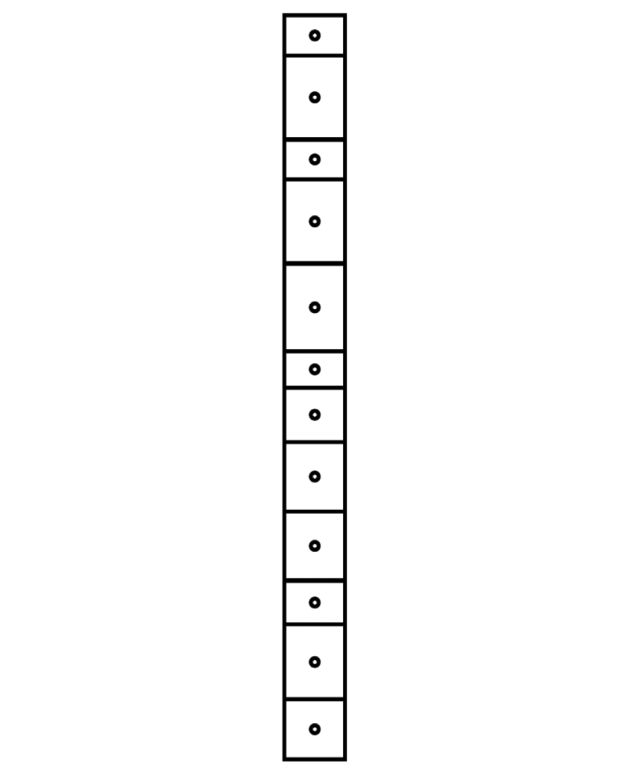
What is novel about this illusion is that the boxes only vary in a dimension unrelated to the perceived misalignment of the dots. In the first example (with horizontally arranged boxes), all the boxes are the same height; therefore, it is not the height of the boxes that distorts the apparent height of the dots but rather their horizontal variability.
So, what explains the Box-Circle illusion?
The authors provide two possible theories of how the Box-Circle illusion might come about:
1. The first possibility is that narrower boxes might appear to be farther away than wider boxes. If this is the case, then certain biases might come into play, causing narrower (i.e., farther) boxes to have different relative heights than wider (i.e., closer boxes).
2. Another possibility is that the vertical lines that separate the boxes present a disruption to the visual process of assessing the dots' heights.
The two theories are not incompatible, and they both could provide cues supporting the illusion. Future research will need to test different conditions, such as brief presentations, to determine which of the theories provides the best explanation for our distorted perception.
Overall, the research by Lin and Shams shows that contextual effects can influence simple geometric judgments in unexpected ways. The processes involved in extracting geometric information from visual stimuli are complex, and even contextual information that is not expected to affect judgments (such as horizontal distances in the judgment of vertical alignment) can still yield a significant influence.
- Questions and Answers
- Opinion
- Motivational and Inspiring Story
- Technology
- Live and Let live
- Focus
- Geopolitics
- Military-Arms/Equipment
- Segurança
- Economy
- Beasts of Nations
- Machine Tools-The “Mother Industry”
- Art
- Causes
- Crafts
- Dance
- Drinks
- Film/Movie
- Fitness
- Food
- Jogos
- Gardening
- Health
- Início
- Literature
- Music
- Networking
- Outro
- Party
- Religion
- Shopping
- Sports
- Theater
- Health and Wellness
- News
- Culture

 Chinese
 English
 Arabic
 French
 Spanish
 Portuguese
 Deutsch
 Turkish
 Dutch
Dutch
 Italiano
 Russian
 Romaian
 Greek
Greek