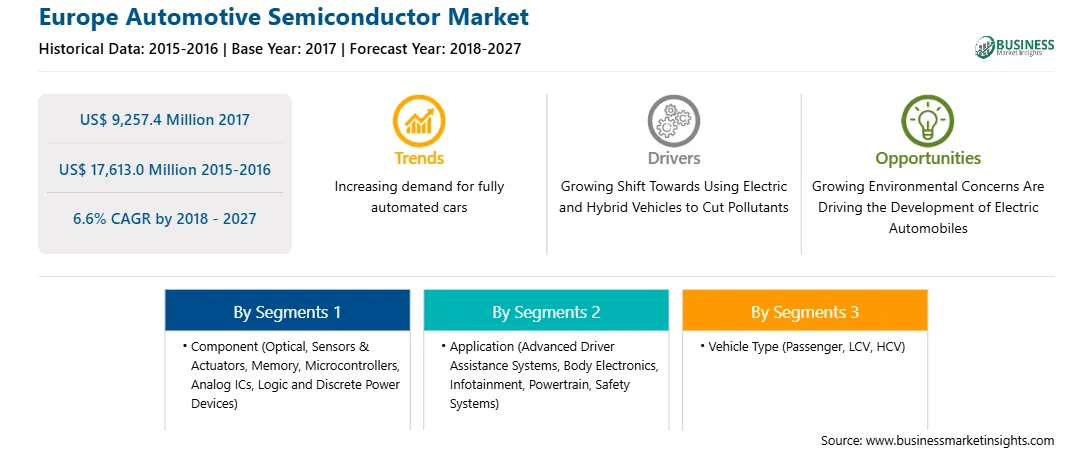
• Market Penetration Rates: Automotive Semiconductors Europe 2027

    Automotive Semiconductor market in Europe is expected to grow from US$ 9,257.4 Mn in 2017 to US$ 17,613.0 Mn by the year 2027. This represents a CAGR of 6.6% from the year 2018 to 2027.

    Get Full Report: https://www.businessmarketinsights.com/reports/europe-automotive-semiconductor-market

    #AutomotiveSemiconductors #AutoChips #EVTechnology #ADAS #VehicleElectronics #SemiconductorMarket #AutomotiveInnovation #ElectricVehicles #AutonomousDriving #ConnectedCars #CarTech #ChipSupplyChain #MobilityTech #STMicroelectronics #Infineon #NXP #2031Outlook #SmartVehicles #AutoIndustry #VehicleSafety
    Market Penetration Rates: Automotive Semiconductors Europe 2027 Automotive Semiconductor market in Europe is expected to grow from US$ 9,257.4 Mn in 2017 to US$ 17,613.0 Mn by the year 2027. This represents a CAGR of 6.6% from the year 2018 to 2027. Get Full Report: https://www.businessmarketinsights.com/reports/europe-automotive-semiconductor-market #AutomotiveSemiconductors #AutoChips #EVTechnology #ADAS #VehicleElectronics #SemiconductorMarket #AutomotiveInnovation #ElectricVehicles #AutonomousDriving #ConnectedCars #CarTech #ChipSupplyChain #MobilityTech #STMicroelectronics #Infineon #NXP #2031Outlook #SmartVehicles #AutoIndustry #VehicleSafety
    WWW.BUSINESSMARKETINSIGHTS.COM
    Europe Automotive Semiconductor Market to Reach US$ 17,613.0 Mn at CAGR of 6.6% in 2027 | Business Market Insights
    Europe Automotive Semiconductor Market is expected to grow from US$ 9,257.4 Mn in 2017 to US$ 17,613.0 Mn by the year 2027 and represents a CAGR of 6.6% from the year 2018 to 2027 segmented into by Component, Application, Vehicle Type.
    0 Kommentare 0 Geteilt 5KB Ansichten 0 Bewertungen
  • The Dragon and The Elephant: China Vs India (Part 2)
    Why China Surpassed India in Technology and Industrial Output.

    Catching up with China is a formidable challenge that requires unwavering political will, broad societal consensus, and consistent execution of well-thought-out strategies over many years. While the path is arduous, a focused and determined India can significantly accelerate its journey towards becoming a global leader in technology, science, and industry.

    For India to bridge the gap with China in technology, science, and industrial output, a multifaceted and sustained national effort is required. This involves strategic interventions across research and development, manufacturing, human capital, infrastructure, and governance. Here’s a deeper insight into what India needs to do:

    1. Turbocharge Research & Development (R&D) and Foster a Robust Innovation Ecosystem:

    Dramatically Increase R&D Investment: India's current R&D spending (around 0.7% of GDP) pales in comparison to China's (over 2.5%). A national mission to elevate this to at least 2-3% of GDP within the next decade is crucial. This requires increased public funding and significant incentives for private sector R&D.

    Strengthen Industry-Academia Collaboration: Create seamless pathways for joint research projects, knowledge transfer, and commercialization of academic innovations. Establish dedicated innovation hubs, research parks, and technology incubators with active industry participation.

    Revamp the Patent Regime: Streamline the patent filing and grant process to make it faster, more efficient, and aligned with global best practices. Strengthen intellectual property rights (IPR) protection to encourage innovation.

    Promote Mission-Oriented Research: Identify and fund national missions in critical and emerging areas like artificial intelligence (AI), quantum computing, advanced materials, green hydrogen, and biotechnology, similar to China’s strategic focus areas.

    Attract and Retain Top Talent: Implement policies to attract global scientific talent (including Indian diaspora) and create conducive environments to retain and nurture domestic researchers.

    2. Transform into a Global Manufacturing Powerhouse:
    Enhance Manufacturing Competitiveness:-
    Scale and Efficiency: Encourage the creation of large-scale manufacturing units capable of competing globally on cost and quality.

    Supply Chain Resilience: Develop robust domestic supply chains for critical components and raw materials to reduce import dependency, learning from China’s integrated approach.

    Technology Adoption: Promote the adoption of Industry 4.0 technologies (AI, IoT, robotics, automation) in manufacturing processes.

    Strategic Industrial Policy:-
    Targeted Support: Continue and refine Production Linked Incentive (PLI) schemes for strategic sectors, ensuring clear goals and accountability.

    Ease of Doing Business: Persistently work on simplifying regulations, reducing bureaucratic hurdles, and ensuring policy stability at both central and state levels. This includes faster approvals, easier land acquisition, and streamlined labor laws.

    Focus on High-Value Manufacturing: Shift focus from low-value assembly to high-value-added manufacturing, including design, engineering, and R&D-intensive production.

    3. Revolutionize Education and Skill Development:-
    Overhaul Technical and Vocational Education:

    Modernize Curricula: Align engineering, polytechnic, and vocational training curricula with current and future industry demands, emphasizing practical skills, problem-solving, and emerging technologies.

    Mass Skilling and Upskilling: Launch large-scale initiatives to skill, reskill, and upskill the workforce for advanced manufacturing, digital technologies, and R&D roles.

    Strengthen Apprenticeships: Expand and strengthen apprenticeship programs with active industry involvement.

    Improve Quality of Higher Education:
    Invest in STEM Excellence: Significantly increase investment in science, technology, engineering, and mathematics (STEM) education at all levels.

    Faculty Development: Implement rigorous training and development programs for faculty in higher education and technical institutions.

    Attract Foreign Universities and Foster Competition: Encourage top global universities to set up campuses in India to enhance quality and provide global exposure, as envisioned in the National Education Policy (NEP) 2020.

    4. Build World-Class, Future-Ready Infrastructure:
    Logistics and Connectivity: Continue the aggressive push for modernizing and expanding infrastructure, including highways (Bharatmala), railways (Dedicated Freight Corridors), ports (Sagarmala), and airports. Focus on multi-modal connectivity and reducing logistics costs and turnaround times, which are critical for manufacturing competitiveness.

    Reliable Power Supply: Ensure uninterrupted, high-quality power at competitive rates for industries.

    Digital Infrastructure: Strengthen and expand high-speed internet connectivity and data centers to support a digitally-driven economy and advanced technological applications.

    Industrial Parks and Clusters: Develop well-equipped industrial parks and sector-specific clusters with plug-and-play infrastructure to attract investment.

    5. Ensure Agile and Enabling Governance:
    Bureaucratic and Regulatory Reforms:
    Speed and Transparency: Implement deep administrative reforms to make bureaucracy more agile, responsive, and transparent. Reduce red tape through single-window clearance systems and extensive use of technology.

    Policy Stability and Predictability: Ensure long-term policy stability and predictability to build investor confidence.

    Effective Centre-State Coordination: Foster greater synergy between central and state governments in policy formulation and implementation related to industrial development, infrastructure, and skill development.

    Strengthen Legal and Judicial Processes: Ensure faster contract enforcement and dispute resolution mechanisms.

    6. Strategically Attract and Nurture Investment:
    Targeted FDI in High-Tech Areas: Proactively seek foreign direct investment in high-technology sectors, R&D, and advanced manufacturing, offering competitive incentives and a stable policy environment.

    Boost Domestic Investment: Encourage domestic companies to invest more in capacity building, technology upgradation, and innovation.

    Develop a Robust Capital Market: Further develop capital markets to provide risk capital and long-term financing for technology ventures and industrial projects.

    7. Focus on Emerging Technologies and Self-Reliance:
    National Strategy for Key Technologies: Develop and implement comprehensive national strategies for emerging technologies like AI, machine learning, semiconductors (e.g., India Semiconductor Mission), 5G/6G, biotechnology, and renewable energy.

    Promote Indigenous Development: While collaborating globally, prioritize indigenous development of critical technologies to enhance self-reliance (Atmanirbhar Bharat) and reduce strategic vulnerabilities.
    Learning from China (Both Successes and Mistakes):

    Emulate Strategic Focus and Execution: Learn from China's ability to set long-term strategic goals and execute them with speed and scale, particularly in infrastructure and targeted industrial development.

    Invest in Human Capital: Replicate China's success in mass education and skilling relevant to industrial needs.

    Avoid Pitfalls: Be cautious of issues like over-reliance on state-led investment leading to potential misallocation, debt overhang, environmental degradation if not managed sustainably, and intellectual property theft concerns that have been associated with China's rise. India's democratic framework, while sometimes slower, can provide checks and balances for more sustainable and equitable growth if harnessed effectively.

    Catching up with China is a monumental task that requires a generational commitment to reform, investment, and execution. It necessitates a "whole-of-nation" approach, involving government, industry, academia, and civil society working in concert towards clearly defined national goals.

    By Jo Ikeji-Uju
    https://afriprime.net/pages/Anything

    The Dragon and The Elephant: China Vs India (Part 2) Why China Surpassed India in Technology and Industrial Output. Catching up with China is a formidable challenge that requires unwavering political will, broad societal consensus, and consistent execution of well-thought-out strategies over many years. While the path is arduous, a focused and determined India can significantly accelerate its journey towards becoming a global leader in technology, science, and industry. For India to bridge the gap with China in technology, science, and industrial output, a multifaceted and sustained national effort is required. This involves strategic interventions across research and development, manufacturing, human capital, infrastructure, and governance. Here’s a deeper insight into what India needs to do: 1. Turbocharge Research & Development (R&D) and Foster a Robust Innovation Ecosystem: Dramatically Increase R&D Investment: India's current R&D spending (around 0.7% of GDP) pales in comparison to China's (over 2.5%). A national mission to elevate this to at least 2-3% of GDP within the next decade is crucial. This requires increased public funding and significant incentives for private sector R&D. Strengthen Industry-Academia Collaboration: Create seamless pathways for joint research projects, knowledge transfer, and commercialization of academic innovations. Establish dedicated innovation hubs, research parks, and technology incubators with active industry participation. Revamp the Patent Regime: Streamline the patent filing and grant process to make it faster, more efficient, and aligned with global best practices. Strengthen intellectual property rights (IPR) protection to encourage innovation. Promote Mission-Oriented Research: Identify and fund national missions in critical and emerging areas like artificial intelligence (AI), quantum computing, advanced materials, green hydrogen, and biotechnology, similar to China’s strategic focus areas. Attract and Retain Top Talent: Implement policies to attract global scientific talent (including Indian diaspora) and create conducive environments to retain and nurture domestic researchers. 2. Transform into a Global Manufacturing Powerhouse: Enhance Manufacturing Competitiveness:- Scale and Efficiency: Encourage the creation of large-scale manufacturing units capable of competing globally on cost and quality. Supply Chain Resilience: Develop robust domestic supply chains for critical components and raw materials to reduce import dependency, learning from China’s integrated approach. Technology Adoption: Promote the adoption of Industry 4.0 technologies (AI, IoT, robotics, automation) in manufacturing processes. Strategic Industrial Policy:- Targeted Support: Continue and refine Production Linked Incentive (PLI) schemes for strategic sectors, ensuring clear goals and accountability. Ease of Doing Business: Persistently work on simplifying regulations, reducing bureaucratic hurdles, and ensuring policy stability at both central and state levels. This includes faster approvals, easier land acquisition, and streamlined labor laws. Focus on High-Value Manufacturing: Shift focus from low-value assembly to high-value-added manufacturing, including design, engineering, and R&D-intensive production. 3. Revolutionize Education and Skill Development:- Overhaul Technical and Vocational Education: Modernize Curricula: Align engineering, polytechnic, and vocational training curricula with current and future industry demands, emphasizing practical skills, problem-solving, and emerging technologies. Mass Skilling and Upskilling: Launch large-scale initiatives to skill, reskill, and upskill the workforce for advanced manufacturing, digital technologies, and R&D roles. Strengthen Apprenticeships: Expand and strengthen apprenticeship programs with active industry involvement. Improve Quality of Higher Education: Invest in STEM Excellence: Significantly increase investment in science, technology, engineering, and mathematics (STEM) education at all levels. Faculty Development: Implement rigorous training and development programs for faculty in higher education and technical institutions. Attract Foreign Universities and Foster Competition: Encourage top global universities to set up campuses in India to enhance quality and provide global exposure, as envisioned in the National Education Policy (NEP) 2020. 4. Build World-Class, Future-Ready Infrastructure: Logistics and Connectivity: Continue the aggressive push for modernizing and expanding infrastructure, including highways (Bharatmala), railways (Dedicated Freight Corridors), ports (Sagarmala), and airports. Focus on multi-modal connectivity and reducing logistics costs and turnaround times, which are critical for manufacturing competitiveness. Reliable Power Supply: Ensure uninterrupted, high-quality power at competitive rates for industries. Digital Infrastructure: Strengthen and expand high-speed internet connectivity and data centers to support a digitally-driven economy and advanced technological applications. Industrial Parks and Clusters: Develop well-equipped industrial parks and sector-specific clusters with plug-and-play infrastructure to attract investment. 5. Ensure Agile and Enabling Governance: Bureaucratic and Regulatory Reforms: Speed and Transparency: Implement deep administrative reforms to make bureaucracy more agile, responsive, and transparent. Reduce red tape through single-window clearance systems and extensive use of technology. Policy Stability and Predictability: Ensure long-term policy stability and predictability to build investor confidence. Effective Centre-State Coordination: Foster greater synergy between central and state governments in policy formulation and implementation related to industrial development, infrastructure, and skill development. Strengthen Legal and Judicial Processes: Ensure faster contract enforcement and dispute resolution mechanisms. 6. Strategically Attract and Nurture Investment: Targeted FDI in High-Tech Areas: Proactively seek foreign direct investment in high-technology sectors, R&D, and advanced manufacturing, offering competitive incentives and a stable policy environment. Boost Domestic Investment: Encourage domestic companies to invest more in capacity building, technology upgradation, and innovation. Develop a Robust Capital Market: Further develop capital markets to provide risk capital and long-term financing for technology ventures and industrial projects. 7. Focus on Emerging Technologies and Self-Reliance: National Strategy for Key Technologies: Develop and implement comprehensive national strategies for emerging technologies like AI, machine learning, semiconductors (e.g., India Semiconductor Mission), 5G/6G, biotechnology, and renewable energy. Promote Indigenous Development: While collaborating globally, prioritize indigenous development of critical technologies to enhance self-reliance (Atmanirbhar Bharat) and reduce strategic vulnerabilities. Learning from China (Both Successes and Mistakes): Emulate Strategic Focus and Execution: Learn from China's ability to set long-term strategic goals and execute them with speed and scale, particularly in infrastructure and targeted industrial development. Invest in Human Capital: Replicate China's success in mass education and skilling relevant to industrial needs. Avoid Pitfalls: Be cautious of issues like over-reliance on state-led investment leading to potential misallocation, debt overhang, environmental degradation if not managed sustainably, and intellectual property theft concerns that have been associated with China's rise. India's democratic framework, while sometimes slower, can provide checks and balances for more sustainable and equitable growth if harnessed effectively. Catching up with China is a monumental task that requires a generational commitment to reform, investment, and execution. It necessitates a "whole-of-nation" approach, involving government, industry, academia, and civil society working in concert towards clearly defined national goals. By Jo Ikeji-Uju https://afriprime.net/pages/Anything

    AFRIPRIME.NET
    Anything Goes
    Share your memories, connect with others, make new friends
    0 Kommentare 0 Geteilt 7KB Ansichten 0 Bewertungen
  • India should have been ahead of China in technology and industrial output, What happened?

    The Dragon and The Elephant: Why China Surpassed India in Technology and Industrial Output
    New Delhi, India & Beijing, China - For decades, observers have noted the immense potential of both India and China. Yet, in the race for technological advancement and industrial supremacy, China has surged significantly ahead, leaving India to play catch-up. While both nations embarked on their modern development journeys around the mid-20th century with comparable challenges, a complex interplay of differing policy choices, strategic implementation, investment priorities, and geopolitical landscapes has led to this divergence.

    Initially, both nations adopted state-led approaches to industrialization. India, after independence in 1947, focused on a mixed economy with significant state control under the "License Raj," which inadvertently stifled private enterprise and innovation. China, following its revolution in 1949, also pursued a centrally planned economy.


    However, the crucial divergence began with the timing and nature of economic reforms. China embarked on far-reaching market-oriented reforms in 1978 under Deng Xiaoping. These reforms were characterized by a strategic focus on export-oriented manufacturing, attracting foreign direct investment (FDI) through Special Economic Zones, and a gradual, yet determined, opening of its economy. This early and decisive shift allowed China to capitalize on global manufacturing trends and build a formidable industrial base.


    India's significant economic liberalization, in contrast, began much later, in 1991. While these reforms were transformative, they were initially driven by a balance of payments crisis and were arguably less strategically focused on building a dominant manufacturing sector from the outset compared to China's approach. India's strength in IT services emerged prominently, but the manufacturing sector did not experience the same exponential growth.

    Investment in Research & Development (R&D) and Education has been another critical differentiating factor. China has consistently and substantially outspent India in R&D. In 2022, China's R&D expenditure stood at approximately 2.55% of its GDP, a stark contrast to India's 0.65%. This commitment has fueled innovation, a surge in patent filings, and the development of high-tech industries like AI and semiconductors.

    In education, while India boasts a highly educated elite, China focused on mass vocational training alongside strategic investments in STEM (Science, Technology, Engineering, and Mathematics) fields through initiatives like "Project 985." This created a skilled workforce crucial for its manufacturing boom and technological advancements. While India is now emphasizing skill development, it has ground to cover.

    Infrastructure development has been a cornerstone of China's strategy. Decades of massive investment in ports, highways, power generation, and logistics created an efficient and cost-effective environment for industrial production. India's infrastructure, while improving significantly in recent years, historically posed a considerable bottleneck, leading to higher logistics costs and impacting manufacturing competitiveness.

    The scale and focus of their manufacturing sectors also tell a significant part of the story. China strategically positioned itself as the "world's factory," leveraging its labor force, state support, and infrastructure to dominate global supply chains. Its manufacturing sector contributes a significantly larger share to its GDP (around 28-30%) and global manufacturing output compared to India's (around 16-17% of GDP and approximately 3% of global output). India's manufacturing growth has faced challenges from rigid labor laws, complex regulatory environments, and lower productivity in certain areas.

    Geopolitical factors and international relations have also played a role. China's ability to attract and absorb FDI, coupled with a relatively stable (though state-controlled) internal environment for much of its high-growth phase, facilitated rapid industrialization. The complex and often tense relationship between India and China has its own set of strategic implications.

    In essence, while India possessed significant potential, China's earlier and more strategically focused economic reforms, massive and sustained investments in R&D and infrastructure, a targeted approach to education for industrial needs, and an aggressive push to become a global manufacturing hub are key reasons for its current lead in technology and industrial output. India is now actively working to address these areas, with initiatives like "Make in India" and increased R&D spending, but bridging the gap will require sustained effort and strategic execution.

    By Jo Ikeji-Uju
    https://afriprime.net/pages/Anything

    India should have been ahead of China in technology and industrial output, What happened? The Dragon and The Elephant: Why China Surpassed India in Technology and Industrial Output New Delhi, India & Beijing, China - For decades, observers have noted the immense potential of both India and China. Yet, in the race for technological advancement and industrial supremacy, China has surged significantly ahead, leaving India to play catch-up. While both nations embarked on their modern development journeys around the mid-20th century with comparable challenges, a complex interplay of differing policy choices, strategic implementation, investment priorities, and geopolitical landscapes has led to this divergence. Initially, both nations adopted state-led approaches to industrialization. India, after independence in 1947, focused on a mixed economy with significant state control under the "License Raj," which inadvertently stifled private enterprise and innovation. China, following its revolution in 1949, also pursued a centrally planned economy. However, the crucial divergence began with the timing and nature of economic reforms. China embarked on far-reaching market-oriented reforms in 1978 under Deng Xiaoping. These reforms were characterized by a strategic focus on export-oriented manufacturing, attracting foreign direct investment (FDI) through Special Economic Zones, and a gradual, yet determined, opening of its economy. This early and decisive shift allowed China to capitalize on global manufacturing trends and build a formidable industrial base. India's significant economic liberalization, in contrast, began much later, in 1991. While these reforms were transformative, they were initially driven by a balance of payments crisis and were arguably less strategically focused on building a dominant manufacturing sector from the outset compared to China's approach. India's strength in IT services emerged prominently, but the manufacturing sector did not experience the same exponential growth. Investment in Research & Development (R&D) and Education has been another critical differentiating factor. China has consistently and substantially outspent India in R&D. In 2022, China's R&D expenditure stood at approximately 2.55% of its GDP, a stark contrast to India's 0.65%. This commitment has fueled innovation, a surge in patent filings, and the development of high-tech industries like AI and semiconductors. In education, while India boasts a highly educated elite, China focused on mass vocational training alongside strategic investments in STEM (Science, Technology, Engineering, and Mathematics) fields through initiatives like "Project 985." This created a skilled workforce crucial for its manufacturing boom and technological advancements. While India is now emphasizing skill development, it has ground to cover. Infrastructure development has been a cornerstone of China's strategy. Decades of massive investment in ports, highways, power generation, and logistics created an efficient and cost-effective environment for industrial production. India's infrastructure, while improving significantly in recent years, historically posed a considerable bottleneck, leading to higher logistics costs and impacting manufacturing competitiveness. The scale and focus of their manufacturing sectors also tell a significant part of the story. China strategically positioned itself as the "world's factory," leveraging its labor force, state support, and infrastructure to dominate global supply chains. Its manufacturing sector contributes a significantly larger share to its GDP (around 28-30%) and global manufacturing output compared to India's (around 16-17% of GDP and approximately 3% of global output). India's manufacturing growth has faced challenges from rigid labor laws, complex regulatory environments, and lower productivity in certain areas. Geopolitical factors and international relations have also played a role. China's ability to attract and absorb FDI, coupled with a relatively stable (though state-controlled) internal environment for much of its high-growth phase, facilitated rapid industrialization. The complex and often tense relationship between India and China has its own set of strategic implications. In essence, while India possessed significant potential, China's earlier and more strategically focused economic reforms, massive and sustained investments in R&D and infrastructure, a targeted approach to education for industrial needs, and an aggressive push to become a global manufacturing hub are key reasons for its current lead in technology and industrial output. India is now actively working to address these areas, with initiatives like "Make in India" and increased R&D spending, but bridging the gap will require sustained effort and strategic execution. By Jo Ikeji-Uju https://afriprime.net/pages/Anything
    AFRIPRIME.NET
    Anything Goes
    Share your memories, connect with others, make new friends
    0 Kommentare 0 Geteilt 4KB Ansichten 0 Bewertungen
  • Rising semiconductor and electronics manufacturing, growing demand for high-purity chemicals, technological advancements in cleaning processes, and expanding applications in photovoltaic and LED industries are key drivers of the electronic wet chemicals market.

    Read more: https://wemarketresearch.com/reports/electronic-wet-chemicals-market/1508

    #Semiconductors #ElectronicsManufacturing #WetChemicals #HighPurityChemicals #TechInnovation #Photovoltaics #LEDTechnology #CleanroomChemicals #ChemicalProcessing #AdvancedMaterials #ElectronicsIndustry #MarketGrowth #ChemicalEngineering #TechTrends #NanoTechnology
    Rising semiconductor and electronics manufacturing, growing demand for high-purity chemicals, technological advancements in cleaning processes, and expanding applications in photovoltaic and LED industries are key drivers of the electronic wet chemicals market. Read more: https://wemarketresearch.com/reports/electronic-wet-chemicals-market/1508 #Semiconductors #ElectronicsManufacturing #WetChemicals #HighPurityChemicals #TechInnovation #Photovoltaics #LEDTechnology #CleanroomChemicals #ChemicalProcessing #AdvancedMaterials #ElectronicsIndustry #MarketGrowth #ChemicalEngineering #TechTrends #NanoTechnology
    WEMARKETRESEARCH.COM
    Electronic Wet Chemicals Market Report | Size, Share, Growth and Statistics
    Electronic Wet Chemicals Market is projected to reach USD 8,624.75 Million by 2034 with a CAGR of 8.2% from 2024 to 2034 Segmented into Product Type, Application, Form, Distribution Channel and Region.
    0 Kommentare 0 Geteilt 5KB Ansichten 0 Bewertungen
  • https://simplywall.st/community/narratives/us/transportation/nasdaq-aal/american-airlines-group/6lz69com-17-ways-to-call-air-new-zealand-customer-service-by-phone-number-chat-and-email-options-a-complete-treatment
    https://www.techinferno.com/index.php?/topic/35723-17-light-ways-to-reach-emirates-airlines-customer-service/
    https://www.techinferno.com/index.php?/topic/35724-8-systematic-ways-to-obtain-support-from-emirates-airlines-customer-service/
    https://simplywall.st/community/narratives/nz/transportation/nzx-air/air-new-zealand-shares/sej7j0h7-99-useful-ways-to-connect-air-new-zealand-customer-service-by-phone-and-email-option
    https://www.backlink.seoworld.in/2025/04/30/15-ways-to-get-in-touch-with-etihad-airways-customer-service-by-call-email-or-chat-options-full-support-guide/
    https://www.techinferno.com/index.php?/topic/35728-14-effective-ways-to-get-help-from-etihad-airways-customer-service-via-phone-email-chat/
    https://www.techinferno.com/index.php?/topic/35726-12-ways-to-reach-etihad-airways-customer-service-by-phone-email-chat-a-full-travel-guide/
    https://www.techinferno.com/index.php?/topic/35727-10-ways-to-contact-etihad-airways-support-using-call-email-or-live-chat-options-explained-guide/
    https://simplywall.st/community/narratives/us/semiconductors/nasdaq-amd/advanced-micro-devices/4fnk2yom-11-ultra-ways-to-reach-all-nippon-airways-customer-service-via-phone-email-or-chat-options-a-comprehensive-guide
    https://hootmix.com/15-ways-to-get-touch-with-alaska-airlines-customer-service/
    https://www.techinferno.com/index.php?/topic/35729-7-ways-to-speak-with-etihad-airways-customer-service-agents-for-booking-baggage-more/
    https://simplywall.st/community/narratives/us/transportation/nasdaq-aal/american-airlines-group/6lz69com-17-ways-to-call-air-new-zealand-customer-service-by-phone-number-chat-and-email-options-a-complete-treatment https://www.techinferno.com/index.php?/topic/35723-17-light-ways-to-reach-emirates-airlines-customer-service/ https://www.techinferno.com/index.php?/topic/35724-8-systematic-ways-to-obtain-support-from-emirates-airlines-customer-service/ https://simplywall.st/community/narratives/nz/transportation/nzx-air/air-new-zealand-shares/sej7j0h7-99-useful-ways-to-connect-air-new-zealand-customer-service-by-phone-and-email-option https://www.backlink.seoworld.in/2025/04/30/15-ways-to-get-in-touch-with-etihad-airways-customer-service-by-call-email-or-chat-options-full-support-guide/ https://www.techinferno.com/index.php?/topic/35728-14-effective-ways-to-get-help-from-etihad-airways-customer-service-via-phone-email-chat/ https://www.techinferno.com/index.php?/topic/35726-12-ways-to-reach-etihad-airways-customer-service-by-phone-email-chat-a-full-travel-guide/ https://www.techinferno.com/index.php?/topic/35727-10-ways-to-contact-etihad-airways-support-using-call-email-or-live-chat-options-explained-guide/ https://simplywall.st/community/narratives/us/semiconductors/nasdaq-amd/advanced-micro-devices/4fnk2yom-11-ultra-ways-to-reach-all-nippon-airways-customer-service-via-phone-email-or-chat-options-a-comprehensive-guide https://hootmix.com/15-ways-to-get-touch-with-alaska-airlines-customer-service/ https://www.techinferno.com/index.php?/topic/35729-7-ways-to-speak-with-etihad-airways-customer-service-agents-for-booking-baggage-more/
    0 Kommentare 0 Geteilt 650 Ansichten 0 Bewertungen
  • https://simplywall.st/community/narratives/us/utilities/nyse-duk/duke-energy/hfus6szp-19-ways-to-call-expedia-customer-service-via-us-phone-email-or-chat-options-a-step-by-step-complete-guide
    https://simplywall.st/community/narratives/us/semiconductors/nasdaq-nvda/nvidia/38a5lz7i-33-ways-to-contact-expedia-customer-service-by-phone-number-and-email-a-step-by-step-guide
    https://simplywall.st/community/narratives/us/utilities/nyse-duk/duke-energy/hfus6szp-19-ways-to-call-expedia-customer-service-via-us-phone-email-or-chat-options-a-step-by-step-complete-guide https://simplywall.st/community/narratives/us/semiconductors/nasdaq-nvda/nvidia/38a5lz7i-33-ways-to-contact-expedia-customer-service-by-phone-number-and-email-a-step-by-step-guide
    SIMPLYWALL.ST
    DUK - 19 Ways to Call Expedia Customer Service via (US) Phone, Email, or Chat Options: A Step-by-Step Complete Guide
    When you need help from Expedia, knowing the right way to reach their customer service can save you time and stress. As a frequent Expedia traveler, I’ve explored every available channel—phone, chat, email, and more—to resolve booking issues, get flight updates, and manage travel plans.
    0 Kommentare 0 Geteilt 958 Ansichten 0 Bewertungen
  • https://simplywall.st/community/narratives/us/semiconductors/nasdaq-amd/advanced-micro-devices/1yksbp7q-how-to-get-through-to-american-airlines-fast
    https://simplywall.st/community/narratives/us/semiconductors/nasdaq-amd/advanced-micro-devices/1yksbp7q-how-to-get-through-to-american-airlines-fast
    SIMPLYWALL.ST
    AMD - How to get through to American Airlines fast
    To get through to American Airlines customer service faster, call their customer service hotline at +1ー (801 ) ー 855 ー5905 US]. Have your confirmation number or booking information ready to expedite the process.
    0 Kommentare 0 Geteilt 405 Ansichten 0 Bewertungen
  • https://simplywall.st/community/narratives/us/energy/nyse-et.pri/energy-transfer/3n5usulr-modify-ana-how-do-i-change-my-ana-reservation
    http://simplywall.st/community/narratives/us/retail/nasdaq-etsy/etsy/dy5sljqc-update-your-flight-how-do-i-change-my-ana-reservation
    https://simplywall.st/community/narratives/nl/semiconductors/ams-asml/asml-holding-shares/tnjsmxb2-reservation-modifications-how-do-i-change-my-ana-reservation
    https://simplywall.st/community/narratives/us/banks/nyse-bns/bank-of-nova-scotia/n9nqusqt-booking-changes-how-do-i-change-my-ana-reservation
    https://simplywall.st/community/narratives/us/banks/nyse-td/toronto-dominion-bank/jczxde3c-flight-change-guide-how-do-i-change-my-ana-reservation
    https://simplywall.st/community/narratives/us/energy/otc-enbh.f/enbridge/28gn1nwh-edit-ana-reservation-how-do-i-change-my-ana-reservation
    https://simplywall.st/community/narratives/us/banks/otc-tdbk.f/toronto-dominion-bank/wf2h79zp-rapid-change-how-do-i-change-my-ana-reservation
    https://simplywall.st/community/narratives/us/energy/otc-enbs.f/enbridge/mfd4gmp3-instant-update-how-do-i-change-my-ana-reservation
    https://simplywall.st/community/narratives/us/energy/otc-enbr.f/enbridge/1kw155ts-proper-guide-how-do-i-change-my-ana-reservation
    https://simplywall.st/community/narratives/us/energy/otc-enbm.f/enbridge/g48byzs9-how-do-i-change-my-ana-reservation
    https://simplywall.st/community/narratives/us/energy/nyse-et.pri/energy-transfer/3n5usulr-modify-ana-how-do-i-change-my-ana-reservation http://simplywall.st/community/narratives/us/retail/nasdaq-etsy/etsy/dy5sljqc-update-your-flight-how-do-i-change-my-ana-reservation https://simplywall.st/community/narratives/nl/semiconductors/ams-asml/asml-holding-shares/tnjsmxb2-reservation-modifications-how-do-i-change-my-ana-reservation https://simplywall.st/community/narratives/us/banks/nyse-bns/bank-of-nova-scotia/n9nqusqt-booking-changes-how-do-i-change-my-ana-reservation https://simplywall.st/community/narratives/us/banks/nyse-td/toronto-dominion-bank/jczxde3c-flight-change-guide-how-do-i-change-my-ana-reservation https://simplywall.st/community/narratives/us/energy/otc-enbh.f/enbridge/28gn1nwh-edit-ana-reservation-how-do-i-change-my-ana-reservation https://simplywall.st/community/narratives/us/banks/otc-tdbk.f/toronto-dominion-bank/wf2h79zp-rapid-change-how-do-i-change-my-ana-reservation https://simplywall.st/community/narratives/us/energy/otc-enbs.f/enbridge/mfd4gmp3-instant-update-how-do-i-change-my-ana-reservation https://simplywall.st/community/narratives/us/energy/otc-enbr.f/enbridge/1kw155ts-proper-guide-how-do-i-change-my-ana-reservation https://simplywall.st/community/narratives/us/energy/otc-enbm.f/enbridge/g48byzs9-how-do-i-change-my-ana-reservation
    SIMPLYWALL.ST
    ET.PRI - [Modify ANA] How do I change my ANA reservation?
    You can make changes to your reservation through the "Change Reservation" button on the "Reservation Details" page on the ANA website. For information on changeable itineraries and conditions, please check [Changes, Charges and Refunds] for reservation changes.
    0 Kommentare 0 Geteilt 631 Ansichten 0 Bewertungen
  • https://simplywall.st/community/narratives/us/energy/nyse-et.pri/energy-transfer/3n5usulr-modify-ana-how-do-i-change-my-ana-reservation
    http://simplywall.st/community/narratives/us/retail/nasdaq-etsy/etsy/dy5sljqc-update-your-flight-how-do-i-change-my-ana-reservation
    https://simplywall.st/community/narratives/nl/semiconductors/ams-asml/asml-holding-shares/tnjsmxb2-reservation-modifications-how-do-i-change-my-ana-reservation
    https://simplywall.st/community/narratives/us/banks/nyse-bns/bank-of-nova-scotia/n9nqusqt-booking-changes-how-do-i-change-my-ana-reservation
    https://simplywall.st/community/narratives/us/banks/nyse-td/toronto-dominion-bank/jczxde3c-flight-change-guide-how-do-i-change-my-ana-reservation
    https://simplywall.st/community/narratives/us/energy/otc-enbh.f/enbridge/28gn1nwh-edit-ana-reservation-how-do-i-change-my-ana-reservation
    https://simplywall.st/community/narratives/us/banks/otc-tdbk.f/toronto-dominion-bank/wf2h79zp-rapid-change-how-do-i-change-my-ana-reservation
    https://simplywall.st/community/narratives/us/energy/otc-enbs.f/enbridge/mfd4gmp3-instant-update-how-do-i-change-my-ana-reservation
    https://simplywall.st/community/narratives/us/energy/otc-enbr.f/enbridge/1kw155ts-proper-guide-how-do-i-change-my-ana-reservation
    https://simplywall.st/community/narratives/us/energy/otc-enbm.f/enbridge/g48byzs9-how-do-i-change-my-ana-reservation
    https://simplywall.st/community/narratives/us/energy/nyse-et.pri/energy-transfer/3n5usulr-modify-ana-how-do-i-change-my-ana-reservation http://simplywall.st/community/narratives/us/retail/nasdaq-etsy/etsy/dy5sljqc-update-your-flight-how-do-i-change-my-ana-reservation https://simplywall.st/community/narratives/nl/semiconductors/ams-asml/asml-holding-shares/tnjsmxb2-reservation-modifications-how-do-i-change-my-ana-reservation https://simplywall.st/community/narratives/us/banks/nyse-bns/bank-of-nova-scotia/n9nqusqt-booking-changes-how-do-i-change-my-ana-reservation https://simplywall.st/community/narratives/us/banks/nyse-td/toronto-dominion-bank/jczxde3c-flight-change-guide-how-do-i-change-my-ana-reservation https://simplywall.st/community/narratives/us/energy/otc-enbh.f/enbridge/28gn1nwh-edit-ana-reservation-how-do-i-change-my-ana-reservation https://simplywall.st/community/narratives/us/banks/otc-tdbk.f/toronto-dominion-bank/wf2h79zp-rapid-change-how-do-i-change-my-ana-reservation https://simplywall.st/community/narratives/us/energy/otc-enbs.f/enbridge/mfd4gmp3-instant-update-how-do-i-change-my-ana-reservation https://simplywall.st/community/narratives/us/energy/otc-enbr.f/enbridge/1kw155ts-proper-guide-how-do-i-change-my-ana-reservation https://simplywall.st/community/narratives/us/energy/otc-enbm.f/enbridge/g48byzs9-how-do-i-change-my-ana-reservation
    SIMPLYWALL.ST
    ET.PRI - [Modify ANA] How do I change my ANA reservation?
    You can make changes to your reservation through the "Change Reservation" button on the "Reservation Details" page on the ANA website. For information on changeable itineraries and conditions, please check [Changes, Charges and Refunds] for reservation changes.
    0 Kommentare 0 Geteilt 614 Ansichten 0 Bewertungen
  • https://www.underwaterdroneforum.com/threads/jetblue_support-24-7-hours-can-you-cancel-a-flight-with-jetblue.25789/
    https://simplywall.st/community/narratives/in/materials/nse-lindeindia/linde-india-shares/aeom6cp6-faqsjetblue24-can-you-cancel-a-flight-with-jetblue
    https://otx.alienvault.com/pulse/6805431d12d929cb2688c05e
    https://otx.alienvault.com/pulse/68054368870b526157f91db5
    https://simplywall.st/community/narratives/nl/semiconductors/ams-asml/asml-holding-shares/mh0853ip-faqsdeskairdelays-is-jetblue-known-for-cancelling-flights
    https://www.underwaterdroneforum.com/threads/disruptions-jetblue-is-jetblue-known-for-cancelling-flights.25820/
    https://otx.alienvault.com/pulse/6805463a6a37a7223da8ec7b
    https://otx.alienvault.com/pulse/6805463e5ceb037d97bd7936
    https://www.underwaterdroneforum.com/threads/faqs-%F0%9D%99%B6%F0%9D%9A%9E%F0%9D%9A%92%F0%9D%9A%8D%F0%9D%9A%8E%F0%9D%99%B5%F0%9D%9A%95%F0%9D%9A%92%F0%9D%9A%90%F0%9D%9A%91%F0%9D%9A%9D%F0%9D%9A%82%F0%9D%9A%8C%F0%9D%9A%91%F0%9D%9A%8E%F0%9D%9A%8D%F0%9D%9A%9E%F0%9D%9A%95%F0%9D%9A%8E-is-jetblue-fully-refundable.25826/
    https://simplywall.st/community/narratives/lk/food-beverage-tobacco/cose-ccs.n0000/ceylon-cold-stores-shares/2t9r76wo-is-jetblue-fully-refundable
    https://otx.alienvault.com/pulse/680548f8fe2f767c6467f350
    https://otx.alienvault.com/pulse/68054950c132e45238436f87
    https://www.underwaterdroneforum.com/threads/jetblue_support-24-7-hours-can-you-cancel-a-flight-with-jetblue.25789/ https://simplywall.st/community/narratives/in/materials/nse-lindeindia/linde-india-shares/aeom6cp6-faqsjetblue24-can-you-cancel-a-flight-with-jetblue https://otx.alienvault.com/pulse/6805431d12d929cb2688c05e https://otx.alienvault.com/pulse/68054368870b526157f91db5 https://simplywall.st/community/narratives/nl/semiconductors/ams-asml/asml-holding-shares/mh0853ip-faqsdeskairdelays-is-jetblue-known-for-cancelling-flights https://www.underwaterdroneforum.com/threads/disruptions-jetblue-is-jetblue-known-for-cancelling-flights.25820/ https://otx.alienvault.com/pulse/6805463a6a37a7223da8ec7b https://otx.alienvault.com/pulse/6805463e5ceb037d97bd7936 https://www.underwaterdroneforum.com/threads/faqs-%F0%9D%99%B6%F0%9D%9A%9E%F0%9D%9A%92%F0%9D%9A%8D%F0%9D%9A%8E%F0%9D%99%B5%F0%9D%9A%95%F0%9D%9A%92%F0%9D%9A%90%F0%9D%9A%91%F0%9D%9A%9D%F0%9D%9A%82%F0%9D%9A%8C%F0%9D%9A%91%F0%9D%9A%8E%F0%9D%9A%8D%F0%9D%9A%9E%F0%9D%9A%95%F0%9D%9A%8E-is-jetblue-fully-refundable.25826/ https://simplywall.st/community/narratives/lk/food-beverage-tobacco/cose-ccs.n0000/ceylon-cold-stores-shares/2t9r76wo-is-jetblue-fully-refundable https://otx.alienvault.com/pulse/680548f8fe2f767c6467f350 https://otx.alienvault.com/pulse/68054950c132e45238436f87
    0 Kommentare 0 Geteilt 962 Ansichten 0 Bewertungen
Weitere Ergebnisse
Gesponsert
Gesponsert
google-site-verification: google037b30823fc02426.html