From Partner to Platform
Nigeria’s scale, geography, and regional leadership make it an attractive security partner. But there is a critical difference between being a partner in security cooperation and becoming a platform for external power competition. When major powers—whether Western, Eastern, or emerging—begin to view a country not primarily as a sovereign actor but as a staging ground, the nature of engagement changes fundamentally.
In such situations, local security challenges become entangled with global rivalries. Decisions are no longer evaluated solely by their benefit to Nigeria’s internal stability, but by how they serve broader strategic contests. History shows that states occupying this role often experience security paradoxes: more foreign attention, yet less autonomous control; more military presence, yet greater insecurity.
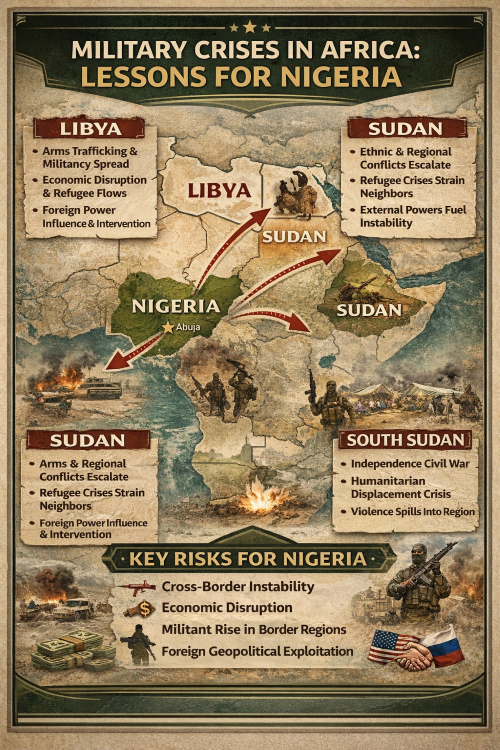
For Nigeria, the risks are not theoretical. They are structural, cumulative, and potentially long-lasting.
1. Loss of Strategic Autonomy
The most profound risk is the erosion of decision-making independence.
When external powers rely on Nigeria as a staging ground:
- Nigerian security priorities may be subtly reframed to align with partner interests
- Threat definitions can be externalized
- Policy options narrow due to implicit expectations
Even without formal alliances, path dependency emerges. Nigeria may find it difficult to refuse requests for access, overflight, basing, or intelligence cooperation without risking diplomatic or security repercussions.
Over time, autonomy is not lost through treaties, but through habitual compliance.
2. Becoming a Proxy Arena Without Consent
External power contests rarely remain abstract. When rival powers compete for influence:
- Intelligence operations expand
- Information warfare intensifies
- Diplomatic pressure increases
- Covert activities multiply
Nigeria risks becoming a proxy environment—not because it chooses conflict, but because it offers strategic value.
In such scenarios:
- Nigerian territory can be used to monitor or counter other powers
- Domestic institutions may be penetrated by competing external interests
- Internal political debates become internationalized
The danger is not open warfare, but persistent low-level contestation that destabilizes governance.
3. Heightened Security Threats and Retaliation Risks
A staging ground attracts attention from adversaries.
If Nigeria is perceived as hosting or enabling external military operations:
- It may become a target for asymmetric retaliation
- Extremist groups may reframe Nigeria as an extension of foreign powers
- Cyber, economic, or information attacks may increase
This risk is particularly acute in:
- Urban centers
- Critical infrastructure
- Energy and transport hubs
- Diplomatic and military facilities
Ironically, the presence intended to enhance security can expand the threat envelope.
4. Internal Legitimacy and Public Trust Erosion
Nigeria’s internal cohesion is already under strain from:
- Economic inequality
- Regional grievances
- Ethno-religious tensions
- Distrust in institutions
Foreign military entanglement can:
- Fuel narratives of neo-imperialism
- Undermine public confidence in national leadership
- Polarize civil-military relations
If citizens perceive that:
- Security decisions are externally driven
- Sovereignty is compromised
- National interests are subordinated
then domestic legitimacy erodes—even if tangible benefits exist.
5. Militarization of Domestic Politics
When Nigeria becomes strategically valuable to external powers:
- Security institutions gain disproportionate influence
- Military cooperation can overshadow civilian oversight
- Defense priorities may crowd out social investment
This creates a military-first policy bias, where:
- Political problems are framed as security threats
- Dialogue and reform are deprioritized
- Long-term development is deferred
Over time, this undermines democratic consolidation and governance balance.
6. Distortion of Nigeria’s Regional Leadership Role
Nigeria’s influence in West Africa depends on perceived impartiality and legitimacy.
As a staging ground:
- Nigeria may be seen as advancing external agendas
- Smaller states may distrust Nigerian initiatives
- ECOWAS cohesion could weaken
Rather than being a consensus-builder, Nigeria risks being viewed as:
- An enforcer
- A proxy leader
- A conduit for external pressure
This would erode decades of diplomatic capital built through peacekeeping and mediation.
7. Strategic Overextension of Nigeria’s Military
Hosting external power contests often entails:
- Increased operational tempo
- Expanded intelligence responsibilities
- Higher expectations of support
Nigeria’s armed forces already face:
- Multiple internal security challenges
- Resource constraints
- Personnel fatigue
Overextension risks:
- Reduced effectiveness domestically
- Dependency on external logistics
- Long-term institutional strain
A military stretched thin becomes less capable, not more.
8. Economic and Developmental Opportunity Costs
Security partnerships often promise:
- Aid
- Training
- Investment
But staging-ground status can also:
- Redirect public funds toward security
- Deter non-aligned investors
- Increase insurance and risk premiums
- Tie infrastructure to military rather than civilian needs
The opportunity cost is subtle but real: development postponed in favor of security maintenance.
9. Legal and Sovereignty Ambiguities
External power presence often operates in:
- Grey legal zones
- Classified agreements
- Executive-level understandings
This creates risks such as:
- Lack of parliamentary oversight
- Jurisdictional ambiguity
- Immunity disputes
- Accountability gaps
Once normalized, such arrangements are difficult to reverse without diplomatic friction.
10. Difficulty Exiting the Role Once Entrenched
Perhaps the most underestimated risk is irreversibility.
Once Nigeria becomes embedded as a staging ground:
- Withdrawal requests provoke pressure
- Infrastructure remains
- Intelligence systems persist
- Expectations harden
Exiting later may require:
- Political confrontation
- Economic trade-offs
- Security recalibration
History shows that it is far easier to enter strategic centrality than to leave it.
11. Strategic Reputation Lock-In
Nigeria risks being labeled internationally as:
- A security state
- A military hub
- A frontline country in global contests
This reputation can:
- Shape future diplomatic options
- Influence foreign investment
- Constrain strategic neutrality
Reputations in geopolitics are sticky.
12. The Core Strategic Paradox
The paradox Nigeria faces is this:
The more strategically useful Nigeria becomes to external powers,
the greater the risk that its own strategic freedom diminishes.
Power attracts attention. Attention attracts contestation. Contestation invites entanglement.
Conclusion: Agency Is the Only Protection
Becoming a staging ground is not inherently disastrous—but it is inherently dangerous without firm national control.
The risks Nigeria faces are not simply military. They are:
- Political
- Institutional
- Economic
- Psychological
- Reputational
The decisive factor is agency:
- Who defines the mission?
- Who controls the infrastructure?
- Who sets the exit conditions?
- Who bears the long-term costs?
Nigeria’s strength lies not just in its size, but in its ability to say no, set terms, and diversify relationships.
In an era of intensifying global competition, the difference between leadership and leverage will determine whether Nigeria emerges as a sovereign regional power—or becomes a contested platform in other nations’ strategies.
History is clear:
Countries that fail to manage this boundary do not lose sovereignty all at once.
They lose it incrementally, invisibly, and structurally.
Leave a Reply