Power Through Access or Power Through Control?
Hosting foreign military coordination places Nigeria at a strategic crossroads. On one hand, access to external military resources, intelligence, training, and diplomatic backing can enhance Nigeria’s influence and deterrence capacity. On the other, hosting external coordination risks constraining Nigeria’s freedom of action, reshaping its security priorities, and embedding external interests into domestic decision-making.
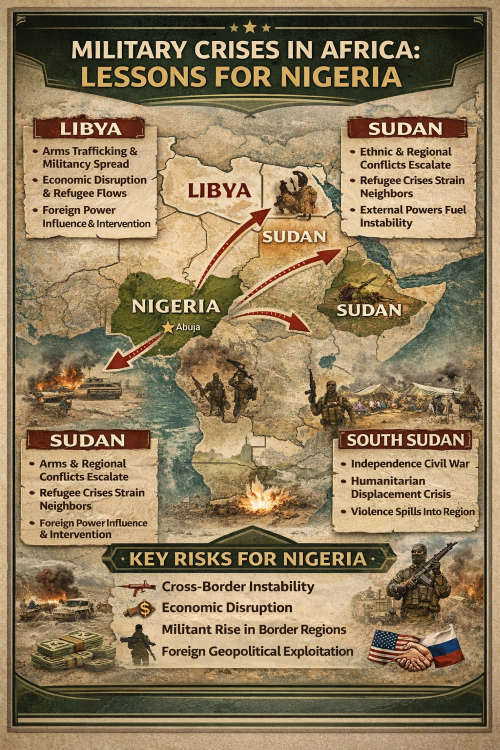
The dilemma is not binary. Nigeria can gain leverage and lose autonomy simultaneously. The net outcome depends not on the presence of foreign coordination itself, but on who controls the terms, duration, and scope of that coordination.
1. The Case for Strategic Leverage
1.1 Enhanced Deterrence and Capability
Foreign military coordination can strengthen Nigeria’s:
- Intelligence, surveillance, and reconnaissance capabilities
- Counterterrorism effectiveness
- Maritime domain awareness
- Rapid response capacity
This enhancement can translate into deterrent credibility—both against non-state threats and against destabilizing regional spillovers.
In a region marked by insurgency, piracy, and transnational crime, such capacity boosts Nigeria’s strategic standing.
1.2 Diplomatic Weight and Bargaining Power
Hosting coordination often increases:
- Diplomatic engagement
- Access to high-level decision-makers
- Leverage in bilateral and multilateral negotiations
Nigeria can use this position to:
- Shape regional security agendas
- Extract concessions (training, equipment, intelligence access)
- Influence external policy toward West Africa
Strategic centrality can become diplomatic currency.
1.3 Agenda-Setting in Regional Security
If Nigeria defines the framework:
- It can steer ECOWAS security architecture
- Anchor multinational operations on its priorities
- Serve as gatekeeper for regional engagement
This allows Nigeria to act as a security broker, not merely a host.
2. The Autonomy Costs
2.1 Path Dependency and Strategic Drift
Once coordination becomes routine:
- Nigeria may rely on external assets
- Alternatives atrophy
- Withdrawal becomes costly
Strategic choices narrow—not by coercion, but by structural dependence.
2.2 Externalization of Threat Perception
Foreign partners often bring:
- Their own threat models
- Global strategic priorities
- Intelligence-driven agendas
Over time, Nigeria risks:
- Adopting external threat hierarchies
- Neglecting local root causes
- Framing domestic issues through foreign lenses
Autonomy erodes when problem definition is outsourced.
2.3 Implicit Conditionalities
Even without formal conditions:
- Access can become leverage
- Cooperation can imply alignment
- Refusal can incur diplomatic or security costs
This creates a soft constraint on policy independence.
3. The Balance Sheet: Leverage vs. Autonomy
| Dimension | Leverage Gain | Autonomy Risk |
|---|---|---|
| Intelligence | Better coverage | Dependence |
| Military capacity | Skill transfer | Doctrine capture |
| Diplomacy | Higher profile | Alignment pressure |
| Regional leadership | Agenda-setting | Perceived proxy role |
| Security outcomes | Short-term gains | Long-term drift |
4. Historical Lessons
History shows that:
- States that set terms gain leverage
- States that accept frameworks lose autonomy
Autonomy loss is gradual, cumulative, and often invisible until it is entrenched.
5. Conditions for Net Strategic Gain
Nigeria gains leverage if it:
- Retains command authority
- Limits permanence
- Diversifies partners
- Maintains civilian oversight
- Defines exit conditions
Absent these, coordination becomes positioning.
Conclusion: The Deciding Variable Is Control
Hosting foreign military coordination is not inherently empowering or disempowering. It is instrumental. Whether Nigeria gains leverage or loses autonomy depends on one decisive factor: control.
- Control over mission definition
- Control over infrastructure
- Control over intelligence priorities
- Control over duration
If Nigeria controls these, coordination enhances leverage.
If others do, autonomy erodes.
In geopolitics, access is power—but control determines who wields it.
Leave a Reply