From “Limited Missions” to Strategic Entrenchment
Counterterrorism missions are almost always framed as narrow, technical, and time-bound. Governments present them as defensive responses to non-state threats, designed to restore stability, protect civilians, or assist allies. Yet history shows a persistent pattern: counterterrorism operations frequently expand beyond their original mandate, evolving into long-term geopolitical interventions with consequences far exceeding the initial justification.
This evolution is not accidental. It is structural. Once military forces, intelligence assets, logistics networks, and diplomatic commitments are established, counterterrorism becomes a gateway to power projection, regional influence, and strategic competition. The question is not whether such missions expand, but how often—and under what conditions—they do so.
Historically, the answer is: very often.
1. Afghanistan: The Archetypal Case of Mission Expansion
No case better illustrates this pattern than Afghanistan (2001–2021).
Initial Mandate
The U.S.-led intervention began as a counterterrorism mission to:
- Destroy al-Qaeda
- Remove the Taliban for harboring it
- Prevent future attacks like 9/11
This objective was achieved relatively quickly. By late 2001, al-Qaeda’s centralized presence was shattered.
Evolution
Within years, the mission expanded into:
- Nation-building
- Democratic institution construction
- Counterinsurgency
- Regional power balancing involving Pakistan, Iran, Russia, and China
Outcome
A 20-year geopolitical intervention involving NATO, trillions of dollars, and deep entanglement in Afghan politics—far beyond counterterrorism.
Lesson: Counterterrorism provided the entry point, but geopolitics sustained the intervention.
2. Iraq: From Terror Suppression to Regional Reordering
Although the 2003 Iraq invasion was not initially justified purely on counterterrorism grounds, counterterrorism quickly became its primary operational narrative.
Initial Shift
After the collapse of the Iraqi state:
- Insurgent and extremist violence surged
- The mission reframed itself as fighting terrorism (al-Qaeda in Iraq, later ISIS)
Expansion
Counterterrorism evolved into:
- Occupation and governance
- Regional competition with Iran
- Permanent basing and influence in the Gulf
- Reshaping Middle Eastern power balances
Recurrence
Even after the formal withdrawal in 2011, the U.S. returned under a counterterrorism justification to fight ISIS—demonstrating how such missions can recur cyclically.
Lesson: Once counterterrorism embeds military infrastructure, exit becomes politically and strategically difficult.
3. The Sahel: France’s Operation Barkhane
Initial Mandate
France intervened in Mali (2013) to:
- Stop jihadist groups from capturing Bamako
- Support the Malian government
Expansion
The mission grew into:
- A regional counterterrorism operation across Mali, Niger, Burkina Faso, and Chad
- Permanent French bases
- Intelligence dominance across the Sahel
- Deep political involvement in local governance
Outcome
Rather than stabilizing the region:
- Violence spread
- Local resentment grew
- Coups occurred
- France was ultimately expelled from several countries
Lesson: Counterterrorism can morph into neo-security governance, triggering nationalist backlash.
4. The Global War on Terror: A Systemic Pattern
The U.S. “Global War on Terror” institutionalized expansion:
Examples
- Yemen: Drone strikes evolved into deep involvement in civil war dynamics
- Somalia: Counterterrorism against al-Shabaab led to long-term basing and political shaping
- Pakistan: Counterterrorism operations strained sovereignty and regional stability
Structural Drivers
Once counterterrorism becomes:
- Budgeted annually
- Embedded in alliances
- Integrated into intelligence doctrine
…it ceases to be temporary.
Lesson: Counterterrorism becomes a permanent condition, not an emergency response.
5. Why Counterterrorism Missions Expand
This historical frequency is driven by five recurring mechanisms:
1. Threat Elasticity
“Terrorism” is an open-ended threat category. Groups fragment, rebrand, or migrate. This allows missions to continue indefinitely without clear victory conditions.
2. Infrastructure Lock-In
Bases, logistics hubs, intelligence partnerships, and local militias create sunk costs that incentivize staying.
3. Alliance Obligations
Once allies depend on foreign support, withdrawal risks:
- Regime collapse
- Loss of credibility
- Regional instability blamed on the departing power
4. Strategic Opportunism
Counterterrorism deployments offer:
- Forward basing
- Surveillance access
- Influence over resource corridors
- Leverage in great-power competition
5. Domestic Political Cover
Counterterrorism provides moral legitimacy. It is easier to justify than openly geopolitical interventions.
6. Cases Where Expansion Did Not Fully Occur (The Exceptions)
To be precise, not every counterterrorism mission becomes geopolitical—but these are exceptions.
Examples
- Short-term hostage rescue operations
- Limited advisory missions with strict legal constraints
- Operations with clear exit conditions and minimal basing
These cases share three features:
- Defined objectives
- Local ownership
- Institutional restraint
Where any of these are absent, expansion is likely.
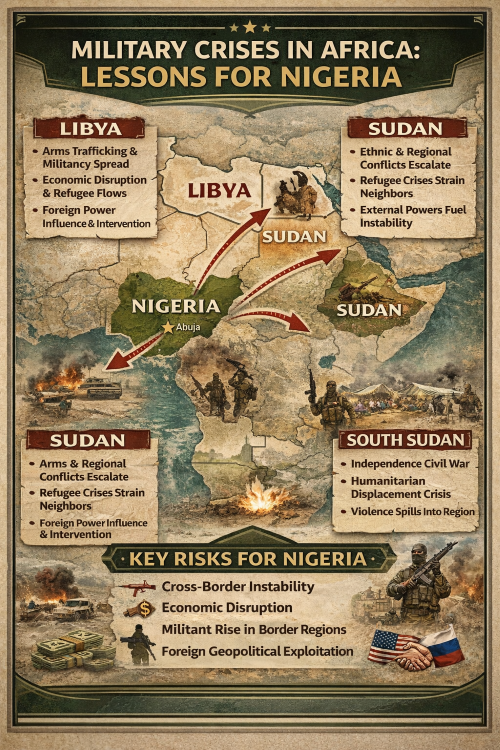
7. The African Context: A High-Risk Environment for Mission Creep
Africa presents particularly fertile ground for this evolution because:
- States face legitimacy challenges
- Borders are porous
- Security threats overlap with economic interests
- External powers compete for influence
As a result, counterterrorism missions often become:
- Tools of alignment (choosing “partners”)
- Gateways to security dependency
- Instruments of geopolitical signaling
This explains why many African populations increasingly question the sincerity of counterterrorism narratives.
8. Frequency Assessment: How Common Is the Pattern?
Based on post-Cold War history:
- Major counterterrorism interventions:
→ Expanded into geopolitical engagements in most cases - Long-term deployments (>5 years):
→ Almost always evolved beyond counterterrorism - Operations involving basing and training:
→ Frequently reshaped local power structures
In practical terms:
Counterterrorism missions evolve into broader geopolitical interventions more often than they remain limited.
Conclusion: Counterterrorism as a Strategic Doorway
Historically, counterterrorism is rarely just about terrorism. It is a strategic doorway—one that opens into diplomacy, influence, competition, and sometimes domination.
This does not mean all counterterrorism is insincere. It means that once violence, alliances, and infrastructure intersect, purely technical missions become politically impossible to contain.
Understanding this pattern is essential—especially for regions like West Africa—because the question is not whether a mission claims to be limited, but whether its structure allows it to remain so.
In history, the answer has usually been no.
Leave a Reply