Blog

  • Does Nigeria Gain Strategic Leverage—or Lose Autonomy—by Hosting Foreign Military Coordination?

    Power Through Access or Power Through Control?

    Hosting foreign military coordination places Nigeria at a strategic crossroads. On one hand, access to external military resources, intelligence, training, and diplomatic backing can enhance Nigeria’s influence and deterrence capacity. On the other, hosting external coordination risks constraining Nigeria’s freedom of action, reshaping its security priorities, and embedding external interests into domestic decision-making.
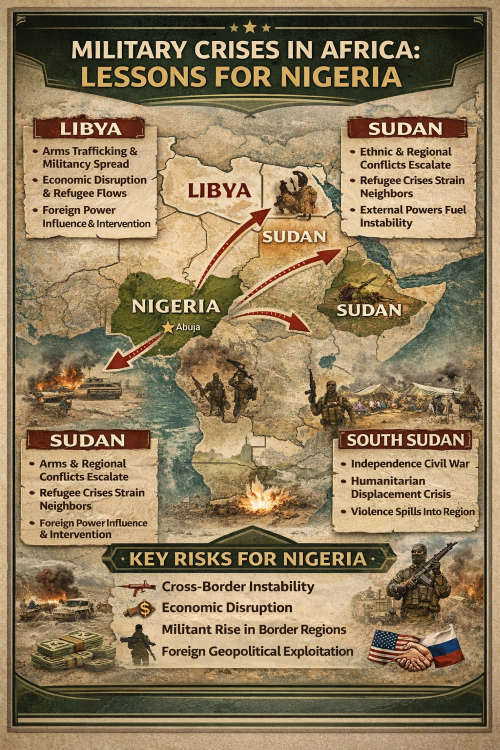
    The dilemma is not binary. Nigeria can gain leverage and lose autonomy simultaneously. The net outcome depends not on the presence of foreign coordination itself, but on who controls the terms, duration, and scope of that coordination.


    1. The Case for Strategic Leverage

    1.1 Enhanced Deterrence and Capability

    Foreign military coordination can strengthen Nigeria’s:

    • Intelligence, surveillance, and reconnaissance capabilities
    • Counterterrorism effectiveness
    • Maritime domain awareness
    • Rapid response capacity

    This enhancement can translate into deterrent credibility—both against non-state threats and against destabilizing regional spillovers.

    In a region marked by insurgency, piracy, and transnational crime, such capacity boosts Nigeria’s strategic standing.


    1.2 Diplomatic Weight and Bargaining Power

    Hosting coordination often increases:

    • Diplomatic engagement
    • Access to high-level decision-makers
    • Leverage in bilateral and multilateral negotiations

    Nigeria can use this position to:

    • Shape regional security agendas
    • Extract concessions (training, equipment, intelligence access)
    • Influence external policy toward West Africa

    Strategic centrality can become diplomatic currency.


    1.3 Agenda-Setting in Regional Security

    If Nigeria defines the framework:

    • It can steer ECOWAS security architecture
    • Anchor multinational operations on its priorities
    • Serve as gatekeeper for regional engagement

    This allows Nigeria to act as a security broker, not merely a host.


    2. The Autonomy Costs

    2.1 Path Dependency and Strategic Drift

    Once coordination becomes routine:

    • Nigeria may rely on external assets
    • Alternatives atrophy
    • Withdrawal becomes costly

    Strategic choices narrow—not by coercion, but by structural dependence.


    2.2 Externalization of Threat Perception

    Foreign partners often bring:

    • Their own threat models
    • Global strategic priorities
    • Intelligence-driven agendas

    Over time, Nigeria risks:

    • Adopting external threat hierarchies
    • Neglecting local root causes
    • Framing domestic issues through foreign lenses

    Autonomy erodes when problem definition is outsourced.


    2.3 Implicit Conditionalities

    Even without formal conditions:

    • Access can become leverage
    • Cooperation can imply alignment
    • Refusal can incur diplomatic or security costs

    This creates a soft constraint on policy independence.


    3. The Balance Sheet: Leverage vs. Autonomy

    DimensionLeverage GainAutonomy Risk
    IntelligenceBetter coverageDependence
    Military capacitySkill transferDoctrine capture
    DiplomacyHigher profileAlignment pressure
    Regional leadershipAgenda-settingPerceived proxy role
    Security outcomesShort-term gainsLong-term drift

    4. Historical Lessons

    History shows that:

    • States that set terms gain leverage
    • States that accept frameworks lose autonomy

    Autonomy loss is gradual, cumulative, and often invisible until it is entrenched.


    5. Conditions for Net Strategic Gain

    Nigeria gains leverage if it:

    • Retains command authority
    • Limits permanence
    • Diversifies partners
    • Maintains civilian oversight
    • Defines exit conditions

    Absent these, coordination becomes positioning.


    Conclusion: The Deciding Variable Is Control

    Hosting foreign military coordination is not inherently empowering or disempowering. It is instrumental. Whether Nigeria gains leverage or loses autonomy depends on one decisive factor: control.

    • Control over mission definition
    • Control over infrastructure
    • Control over intelligence priorities
    • Control over duration

    If Nigeria controls these, coordination enhances leverage.
    If others do, autonomy erodes.

    In geopolitics, access is power—but control determines who wields it.
  • What Risks Does Nigeria Face If It Becomes a Staging Ground for External Power Contests?

    From Partner to Platform

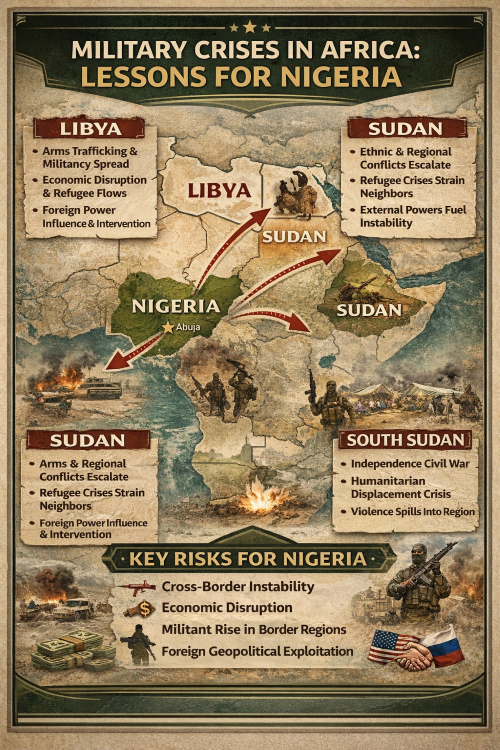
    Nigeria’s scale, geography, and regional leadership make it an attractive security partner. But there is a critical difference between being a partner in security cooperation and becoming a platform for external power competition. When major powers—whether Western, Eastern, or emerging—begin to view a country not primarily as a sovereign actor but as a staging ground, the nature of engagement changes fundamentally.

    In such situations, local security challenges become entangled with global rivalries. Decisions are no longer evaluated solely by their benefit to Nigeria’s internal stability, but by how they serve broader strategic contests. History shows that states occupying this role often experience security paradoxes: more foreign attention, yet less autonomous control; more military presence, yet greater insecurity.

    For Nigeria, the risks are not theoretical. They are structural, cumulative, and potentially long-lasting.


    1. Loss of Strategic Autonomy

    The most profound risk is the erosion of decision-making independence.

    When external powers rely on Nigeria as a staging ground:

    • Nigerian security priorities may be subtly reframed to align with partner interests
    • Threat definitions can be externalized
    • Policy options narrow due to implicit expectations

    Even without formal alliances, path dependency emerges. Nigeria may find it difficult to refuse requests for access, overflight, basing, or intelligence cooperation without risking diplomatic or security repercussions.

    Over time, autonomy is not lost through treaties, but through habitual compliance.


    2. Becoming a Proxy Arena Without Consent

    External power contests rarely remain abstract. When rival powers compete for influence:

    • Intelligence operations expand
    • Information warfare intensifies
    • Diplomatic pressure increases
    • Covert activities multiply

    Nigeria risks becoming a proxy environment—not because it chooses conflict, but because it offers strategic value.

    In such scenarios:

    • Nigerian territory can be used to monitor or counter other powers
    • Domestic institutions may be penetrated by competing external interests
    • Internal political debates become internationalized

    The danger is not open warfare, but persistent low-level contestation that destabilizes governance.


    3. Heightened Security Threats and Retaliation Risks

    A staging ground attracts attention from adversaries.

    If Nigeria is perceived as hosting or enabling external military operations:

    • It may become a target for asymmetric retaliation
    • Extremist groups may reframe Nigeria as an extension of foreign powers
    • Cyber, economic, or information attacks may increase

    This risk is particularly acute in:

    • Urban centers
    • Critical infrastructure
    • Energy and transport hubs
    • Diplomatic and military facilities

    Ironically, the presence intended to enhance security can expand the threat envelope.


    4. Internal Legitimacy and Public Trust Erosion

    Nigeria’s internal cohesion is already under strain from:

    • Economic inequality
    • Regional grievances
    • Ethno-religious tensions
    • Distrust in institutions

    Foreign military entanglement can:

    • Fuel narratives of neo-imperialism
    • Undermine public confidence in national leadership
    • Polarize civil-military relations

    If citizens perceive that:

    • Security decisions are externally driven
    • Sovereignty is compromised
    • National interests are subordinated

    then domestic legitimacy erodes—even if tangible benefits exist.


    5. Militarization of Domestic Politics

    When Nigeria becomes strategically valuable to external powers:

    • Security institutions gain disproportionate influence
    • Military cooperation can overshadow civilian oversight
    • Defense priorities may crowd out social investment

    This creates a military-first policy bias, where:

    • Political problems are framed as security threats
    • Dialogue and reform are deprioritized
    • Long-term development is deferred

    Over time, this undermines democratic consolidation and governance balance.


    6. Distortion of Nigeria’s Regional Leadership Role

    Nigeria’s influence in West Africa depends on perceived impartiality and legitimacy.

    As a staging ground:

    • Nigeria may be seen as advancing external agendas
    • Smaller states may distrust Nigerian initiatives
    • ECOWAS cohesion could weaken

    Rather than being a consensus-builder, Nigeria risks being viewed as:

    • An enforcer
    • A proxy leader
    • A conduit for external pressure

    This would erode decades of diplomatic capital built through peacekeeping and mediation.


    7. Strategic Overextension of Nigeria’s Military

    Hosting external power contests often entails:

    • Increased operational tempo
    • Expanded intelligence responsibilities
    • Higher expectations of support

    Nigeria’s armed forces already face:

    • Multiple internal security challenges
    • Resource constraints
    • Personnel fatigue

    Overextension risks:

    • Reduced effectiveness domestically
    • Dependency on external logistics
    • Long-term institutional strain

    A military stretched thin becomes less capable, not more.


    8. Economic and Developmental Opportunity Costs

    Security partnerships often promise:

    • Aid
    • Training
    • Investment

    But staging-ground status can also:

    • Redirect public funds toward security
    • Deter non-aligned investors
    • Increase insurance and risk premiums
    • Tie infrastructure to military rather than civilian needs

    The opportunity cost is subtle but real: development postponed in favor of security maintenance.


    9. Legal and Sovereignty Ambiguities

    External power presence often operates in:

    • Grey legal zones
    • Classified agreements
    • Executive-level understandings

    This creates risks such as:

    • Lack of parliamentary oversight
    • Jurisdictional ambiguity
    • Immunity disputes
    • Accountability gaps

    Once normalized, such arrangements are difficult to reverse without diplomatic friction.


    10. Difficulty Exiting the Role Once Entrenched

    Perhaps the most underestimated risk is irreversibility.

    Once Nigeria becomes embedded as a staging ground:

    • Withdrawal requests provoke pressure
    • Infrastructure remains
    • Intelligence systems persist
    • Expectations harden

    Exiting later may require:

    • Political confrontation
    • Economic trade-offs
    • Security recalibration

    History shows that it is far easier to enter strategic centrality than to leave it.


    11. Strategic Reputation Lock-In

    Nigeria risks being labeled internationally as:

    • A security state
    • A military hub
    • A frontline country in global contests

    This reputation can:

    • Shape future diplomatic options
    • Influence foreign investment
    • Constrain strategic neutrality

    Reputations in geopolitics are sticky.


    12. The Core Strategic Paradox

    The paradox Nigeria faces is this:

    The more strategically useful Nigeria becomes to external powers,
    the greater the risk that its own strategic freedom diminishes.

    Power attracts attention. Attention attracts contestation. Contestation invites entanglement.


    Conclusion: Agency Is the Only Protection

    Becoming a staging ground is not inherently disastrous—but it is inherently dangerous without firm national control.

    The risks Nigeria faces are not simply military. They are:

    • Political
    • Institutional
    • Economic
    • Psychological
    • Reputational

    The decisive factor is agency:

    • Who defines the mission?
    • Who controls the infrastructure?
    • Who sets the exit conditions?
    • Who bears the long-term costs?

    Nigeria’s strength lies not just in its size, but in its ability to say no, set terms, and diversify relationships.

    In an era of intensifying global competition, the difference between leadership and leverage will determine whether Nigeria emerges as a sovereign regional power—or becomes a contested platform in other nations’ strategies.

    History is clear:
    Countries that fail to manage this boundary do not lose sovereignty all at once.
    They lose it incrementally, invisibly, and structurally.

  • Nigeria as a Strategic Launchpad- Why is Nigeria uniquely positioned as a military and logistical hub in West Africa?

    Nigeria as a Strategic Launchpad

    Why Nigeria Is Uniquely Positioned as a Military and Logistical Hub in West Africa

    Beyond Size—Toward Strategic Centrality

    Nigeria’s importance in West Africa is often reduced to numbers: population size, GDP, oil production, or troop contributions to peacekeeping missions. While these factors matter, they do not fully explain why Nigeria repeatedly emerges—implicitly or explicitly—as a preferred military and logistical anchor for external powers operating in West Africa.

    Nigeria’s true value lies not just in its scale, but in its geostrategic geometry. It sits at the intersection of coastal access, Sahelian depth, demographic mass, infrastructure density, and regional legitimacy. These attributes combine to make Nigeria not merely another partner state, but a strategic launchpad—a platform from which influence, logistics, and security operations can radiate across West Africa and into the Sahel.


    1. Geographic Centrality: Nigeria as the Pivot State

    Nigeria occupies a central hinge position in West Africa:

    • It borders four countries directly (Benin, Niger, Chad, Cameroon)
    • It lies between the Atlantic coast and the Sahel
    • It straddles multiple ecological and security zones: coastal, forest, savannah, and semi-arid

    This geography allows Nigeria to function as:

    • A coastal gateway for maritime access
    • A land bridge into the Sahel
    • A buffer zone between fragile inland states and the Gulf of Guinea

    From a military planning perspective, Nigeria enables multi-directional reach. Forces, supplies, intelligence assets, and communications based in Nigeria can support operations westward (Benin, Togo, Ghana), northward (Niger, Chad), eastward (Cameroon, Lake Chad Basin), and offshore (Gulf of Guinea).

    No other West African country offers this combination of depth, access, and centrality.


    2. Demographic and Human Capital Depth

    With over 200 million people, Nigeria provides:

    • A vast recruitment base
    • A large pool of technical, engineering, and logistics personnel
    • Indigenous language, cultural, and regional knowledge critical for operations

    For external military actors, Nigeria offers something rare: scale without total dependency. Unlike smaller states, Nigeria can host or cooperate without appearing as a client state. This creates political cover for sustained engagement.

    Additionally:

    • Nigerian officers have extensive experience in multinational operations
    • The country has produced generations of military leadership integrated into regional and global security networks

    This human capital reduces the transaction cost of coordination and integration.


    3. Infrastructure Density: Ports, Roads, Airfields, and Networks

    Nigeria’s infrastructure—though uneven and often strained—is denser and more diversified than that of its neighbors.

    Key assets include:

    • Major seaports (Lagos, Port Harcourt, Onne)
    • Multiple international airports with heavy-lift capability
    • Extensive road networks linking coast to interior
    • Telecommunications and energy infrastructure supporting command and control

    From a logistical standpoint, Nigeria allows:

    • Rapid importation of equipment
    • Storage and redistribution of supplies
    • Rotation of personnel
    • Medical evacuation and sustainment operations

    In contrast, Sahelian states often lack:

    • Reliable ports
    • Redundant airfields
    • Secure supply corridors

    This makes Nigeria the rear logistics base even when operations occur elsewhere.


    4. Existing Military Capacity and Regional Legitimacy

    Nigeria possesses the largest and most experienced military force in West Africa. While not without challenges, its armed forces have:

    • Combat experience across multiple theaters
    • Institutional familiarity with counterinsurgency and peacekeeping
    • Command structures capable of coordinating multinational forces

    Crucially, Nigeria’s leadership role in:

    • ECOWAS
    • ECOMOG
    • African Union missions

    provides regional legitimacy that external powers cannot generate independently.

    Operating with Nigeria often appears more acceptable than operating over Nigeria.


    5. Nigeria as the Anchor of ECOWAS Security Architecture

    Nigeria is the de facto security backbone of ECOWAS.

    • It contributes the majority of troops and funding
    • It shapes regional security doctrine
    • It provides political leadership during crises

    This means that any external military coordination with ECOWAS implicitly passes through Nigeria—either formally or informally.

    For external powers, Nigeria functions as:

    • A gatekeeper state
    • A legitimizing intermediary
    • A bridge between national and regional frameworks

    This role magnifies Nigeria’s strategic value far beyond its borders.


    6. Maritime Significance: The Gulf of Guinea Factor

    Nigeria anchors the Gulf of Guinea, one of the world’s most strategic maritime zones:

    • Major energy shipping lanes
    • Critical undersea communication cables
    • High-volume commercial traffic
    • Persistent piracy and maritime insecurity risks

    Control, monitoring, or cooperation in Nigerian waters enables:

    • Maritime domain awareness across the Gulf
    • Protection of global trade routes
    • Surveillance of offshore energy infrastructure

    Any power concerned with maritime security in West Africa must engage Nigeria—not as an option, but as a necessity.


    7. Security Spillover Dynamics: Nigeria as Containment Hub

    Nigeria sits adjacent to multiple security fault lines:

    • Lake Chad Basin insurgency
    • Sahelian instability
    • Cross-border banditry
    • Maritime crime

    Because threats spill into Nigeria rather than solely from it, external military cooperation can be framed as defensive and stabilizing, even when it enables regional reach.

    This makes Nigeria an ideal containment hub:

    • Threats are addressed before reaching coastal or global trade nodes
    • Operations can be justified under mutual defense

    8. Political Weight and Strategic Ambiguity

    Nigeria maintains a tradition of strategic non-alignment rhetoric, even while cooperating with multiple global powers.

    This ambiguity is valuable:

    • It allows external powers to engage without forcing Nigeria into overt alliance blocs
    • It enables Nigeria to host cooperation without formal basing agreements
    • It reduces domestic backlash compared to smaller, more visibly dependent states

    From a strategic perspective, Nigeria offers access without overt alignment—a highly prized condition in competitive geopolitical environments.


    9. Why Nigeria, Not the Sahel, Becomes the Launchpad

    Recent history shows that Sahelian states are:

    • Politically volatile
    • Resistant to prolonged foreign military presence
    • Increasingly nationalist in response to perceived external control

    Nigeria, by contrast:

    • Retains institutional continuity
    • Has stronger civilian-military structures
    • Possesses diplomatic resilience

    Thus, while operations may target the Sahel, Nigeria becomes the staging ground.


    10. The Strategic Risk for Nigeria

    This positioning is not cost-free.

    Risks include:

    • Becoming entangled in external power competition
    • Internal backlash against perceived loss of sovereignty
    • Being targeted by groups reacting to external presence
    • Strategic overextension of Nigeria’s own security forces

    The difference between leadership and leverage depends on Nigeria’s ability to set terms, not merely host cooperation.


    Conclusion: Nigeria as Platform, Not Periphery

    Nigeria’s role as a military and logistical hub is not accidental. It is the product of:

    • Geographic centrality
    • Demographic depth
    • Infrastructure scale
    • Military capacity
    • Regional legitimacy
    • Political weight

    Together, these factors make Nigeria less a frontline battlefield and more a strategic platform—a launchpad from which security, influence, and power can be projected across West Africa.

    The decisive question going forward is not whether Nigeria will be used as such a hub, but whether Nigeria will shape that role deliberately—or have it shaped for it.

    In geopolitics, launchpads are never neutral. They are either instruments of agency or objects of positioning.

  • At What Point Does “Security Cooperation” Become Strategic Positioning?

    The Thin Line Between Assistance and Advantage

    “Security cooperation” is among the most frequently used phrases in contemporary international relations. It conveys reassurance: partnership, capacity-building, mutual benefit, and respect for sovereignty. Yet history and practice reveal that security cooperation is often not an endpoint, but a means. The same activities—training, joint exercises, intelligence sharing, basing access—can either strengthen a partner’s security or gradually embed an external power’s strategic interests into the host state’s security architecture.

    The critical question is not whether security cooperation can be benign, but when it ceases to be primarily cooperative and becomes strategic positioning. The transition is usually subtle, incremental, and officially denied while it is happening.


    1. Defining the Two Concepts

    Security Cooperation

    Security cooperation, in its narrow sense, refers to:

    • Training and professionalization of local forces
    • Intelligence and information sharing
    • Limited joint exercises
    • Equipment transfers for defensive purposes
    • Advisory roles without operational command

    Its defining features are:

    • Host-nation primacy
    • Time-bound or task-specific engagement
    • No permanent foreign force posture
    • Clear alignment with domestic security needs

    Strategic Positioning

    Strategic positioning involves:

    • Establishing long-term military access
    • Forward basing or pre-positioned assets
    • Persistent intelligence, surveillance, and reconnaissance (ISR)
    • Shaping local doctrine, procurement, and threat perception
    • Leveraging security ties for geopolitical influence

    The difference is not the activity but the intent, duration, and structural consequences.


    2. The Inflection Point: When the Mission Stops Being Symmetric

    Security cooperation becomes strategic positioning when the relationship shifts from mutual support to asymmetric dependence.

    This occurs when:

    • One partner becomes indispensable to the other’s security
    • Withdrawal would cause institutional collapse or major instability
    • Decision-making authority migrates informally to the external actor

    At this point, the host state is no longer simply receiving assistance—it is hosting influence.


    3. The Five Structural Markers of Transition

    1. Permanence Replaces Temporariness

    The most reliable indicator is time.

    • Short-term training missions can be cooperative.
    • Indefinite deployments signal positioning.

    When no clear exit conditions exist, security cooperation has crossed into strategic posture. Temporary arrangements become normalized, and “renewals” replace conclusions.


    2. Infrastructure Outlives the Threat

    Security cooperation becomes strategic positioning when:

    • Bases, logistics hubs, or airstrips remain after the original threat changes
    • Facilities are upgraded beyond immediate needs
    • Assets serve regional rather than local security purposes

    Infrastructure is never neutral. It anchors presence and enables power projection.


    3. Intelligence Integration Without Reciprocity

    Information-sharing is cooperative when it is balanced. It becomes positioning when:

    • One party controls collection platforms (drones, satellites, signals intelligence)
    • The host relies on external intelligence for core security decisions
    • Data flows primarily outward

    Control of intelligence equals control of threat narratives—and therefore policy.


    4. Doctrine and Procurement Capture

    A decisive shift occurs when:

    • Local forces are trained to operate only with foreign systems
    • Weapons, maintenance, and upgrades depend on external suppliers
    • Strategic doctrines mirror those of the partner rather than local realities

    At this stage, security cooperation reshapes sovereignty at the structural level.


    5. Security Ties Begin to Shape Foreign Policy

    The final marker appears when:

    • Host states align diplomatically with their security partner
    • Military cooperation affects voting behavior, alliance choices, or neutrality
    • Refusal to cooperate carries implicit security penalties

    Security cooperation has now become leverage.


    4. Why the Transition Is Rarely Acknowledged

    No actor publicly declares a shift to strategic positioning because:

    • It provokes domestic backlash in the host country
    • It raises legal and sovereignty concerns
    • It triggers counter-moves by rival powers

    Thus, the language remains frozen—“partnership,” “support,” “capacity building”—even as the substance changes.


    5. Counterterrorism as the Primary Vehicle

    Counterterrorism is the most common pathway because:

    • Threats are diffuse and unending
    • Success is hard to measure
    • Moral framing discourages scrutiny

    Once counterterrorism cooperation includes:

    • Joint targeting
    • Persistent ISR
    • Special forces integration

    …it has already moved beyond cooperation into operational positioning.


    6. The African Context: Why the Line Is Especially Thin

    In many African states:

    • Security institutions are under-resourced
    • Political legitimacy is contested
    • Borders are expansive and porous

    This makes external support attractive—but also risky.

    Security cooperation becomes strategic positioning faster when:

    • External forces substitute rather than supplement local capacity
    • Regional security architecture is shaped externally
    • Multiple powers compete through security partnerships

    The result is not neutral security enhancement, but strategic contestation on African soil.


    7. Can Security Cooperation Remain Non-Strategic?

    Yes—but only under strict conditions:

    • Clear legal frameworks with parliamentary oversight
    • Sunset clauses and withdrawal benchmarks
    • Host control over intelligence priorities
    • Diversified partnerships to prevent dependency
    • Civilian-led security governance

    Without these safeguards, cooperation drifts.


    8. The Core Test: Who Loses If the Partner Leaves?

    The most honest diagnostic question is this:

    If the external partner withdraws tomorrow, who loses the most?

    • If both lose marginally → cooperation
    • If the host state collapses → strategic positioning
    • If the external power loses regional access → strategic positioning

    Security cooperation becomes strategic positioning when presence itself becomes the objective.


    Conclusion: The Moment Is Structural, Not Declarative

    Security cooperation does not become strategic positioning because someone announces it. It becomes so when:

    • Time stretches
    • Infrastructure embeds
    • Intelligence centralizes
    • Doctrine aligns
    • Policy bends

    At that point, the relationship has crossed from helping manage insecurity to shaping the strategic environment.

    In international politics, the line is crossed quietly—but its consequences are enduring.

  • How Often Have Counterterrorism Missions Historically Evolved into Broader Geopolitical Interventions?

    From “Limited Missions” to Strategic Entrenchment

    Counterterrorism missions are almost always framed as narrow, technical, and time-bound. Governments present them as defensive responses to non-state threats, designed to restore stability, protect civilians, or assist allies. Yet history shows a persistent pattern: counterterrorism operations frequently expand beyond their original mandate, evolving into long-term geopolitical interventions with consequences far exceeding the initial justification.

    This evolution is not accidental. It is structural. Once military forces, intelligence assets, logistics networks, and diplomatic commitments are established, counterterrorism becomes a gateway to power projection, regional influence, and strategic competition. The question is not whether such missions expand, but how often—and under what conditions—they do so.

    Historically, the answer is: very often.


    1. Afghanistan: The Archetypal Case of Mission Expansion

    No case better illustrates this pattern than Afghanistan (2001–2021).

    Initial Mandate

    The U.S.-led intervention began as a counterterrorism mission to:

    • Destroy al-Qaeda
    • Remove the Taliban for harboring it
    • Prevent future attacks like 9/11

    This objective was achieved relatively quickly. By late 2001, al-Qaeda’s centralized presence was shattered.

    Evolution

    Within years, the mission expanded into:

    • Nation-building
    • Democratic institution construction
    • Counterinsurgency
    • Regional power balancing involving Pakistan, Iran, Russia, and China

    Outcome

    A 20-year geopolitical intervention involving NATO, trillions of dollars, and deep entanglement in Afghan politics—far beyond counterterrorism.

    Lesson: Counterterrorism provided the entry point, but geopolitics sustained the intervention.


    2. Iraq: From Terror Suppression to Regional Reordering

    Although the 2003 Iraq invasion was not initially justified purely on counterterrorism grounds, counterterrorism quickly became its primary operational narrative.

    Initial Shift

    After the collapse of the Iraqi state:

    • Insurgent and extremist violence surged
    • The mission reframed itself as fighting terrorism (al-Qaeda in Iraq, later ISIS)

    Expansion

    Counterterrorism evolved into:

    • Occupation and governance
    • Regional competition with Iran
    • Permanent basing and influence in the Gulf
    • Reshaping Middle Eastern power balances

    Recurrence

    Even after the formal withdrawal in 2011, the U.S. returned under a counterterrorism justification to fight ISIS—demonstrating how such missions can recur cyclically.

    Lesson: Once counterterrorism embeds military infrastructure, exit becomes politically and strategically difficult.


    3. The Sahel: France’s Operation Barkhane

    Initial Mandate

    France intervened in Mali (2013) to:

    • Stop jihadist groups from capturing Bamako
    • Support the Malian government

    Expansion

    The mission grew into:

    • A regional counterterrorism operation across Mali, Niger, Burkina Faso, and Chad
    • Permanent French bases
    • Intelligence dominance across the Sahel
    • Deep political involvement in local governance

    Outcome

    Rather than stabilizing the region:

    • Violence spread
    • Local resentment grew
    • Coups occurred
    • France was ultimately expelled from several countries

    Lesson: Counterterrorism can morph into neo-security governance, triggering nationalist backlash.


    4. The Global War on Terror: A Systemic Pattern

    The U.S. “Global War on Terror” institutionalized expansion:

    Examples

    • Yemen: Drone strikes evolved into deep involvement in civil war dynamics
    • Somalia: Counterterrorism against al-Shabaab led to long-term basing and political shaping
    • Pakistan: Counterterrorism operations strained sovereignty and regional stability

    Structural Drivers

    Once counterterrorism becomes:

    • Budgeted annually
    • Embedded in alliances
    • Integrated into intelligence doctrine

    …it ceases to be temporary.

    Lesson: Counterterrorism becomes a permanent condition, not an emergency response.


    5. Why Counterterrorism Missions Expand

    This historical frequency is driven by five recurring mechanisms:

    1. Threat Elasticity

    “Terrorism” is an open-ended threat category. Groups fragment, rebrand, or migrate. This allows missions to continue indefinitely without clear victory conditions.

    2. Infrastructure Lock-In

    Bases, logistics hubs, intelligence partnerships, and local militias create sunk costs that incentivize staying.

    3. Alliance Obligations

    Once allies depend on foreign support, withdrawal risks:

    • Regime collapse
    • Loss of credibility
    • Regional instability blamed on the departing power

    4. Strategic Opportunism

    Counterterrorism deployments offer:

    • Forward basing
    • Surveillance access
    • Influence over resource corridors
    • Leverage in great-power competition

    5. Domestic Political Cover

    Counterterrorism provides moral legitimacy. It is easier to justify than openly geopolitical interventions.


    6. Cases Where Expansion Did Not Fully Occur (The Exceptions)

    To be precise, not every counterterrorism mission becomes geopolitical—but these are exceptions.

    Examples

    • Short-term hostage rescue operations
    • Limited advisory missions with strict legal constraints
    • Operations with clear exit conditions and minimal basing

    These cases share three features:

    • Defined objectives
    • Local ownership
    • Institutional restraint

    Where any of these are absent, expansion is likely.


    7. The African Context: A High-Risk Environment for Mission Creep

    Africa presents particularly fertile ground for this evolution because:

    • States face legitimacy challenges
    • Borders are porous
    • Security threats overlap with economic interests
    • External powers compete for influence

    As a result, counterterrorism missions often become:

    • Tools of alignment (choosing “partners”)
    • Gateways to security dependency
    • Instruments of geopolitical signaling

    This explains why many African populations increasingly question the sincerity of counterterrorism narratives.


    8. Frequency Assessment: How Common Is the Pattern?

    Based on post-Cold War history:

    • Major counterterrorism interventions:
      → Expanded into geopolitical engagements in most cases
    • Long-term deployments (>5 years):
      → Almost always evolved beyond counterterrorism
    • Operations involving basing and training:
      → Frequently reshaped local power structures

    In practical terms:

    Counterterrorism missions evolve into broader geopolitical interventions more often than they remain limited.


    Conclusion: Counterterrorism as a Strategic Doorway

    Historically, counterterrorism is rarely just about terrorism. It is a strategic doorway—one that opens into diplomacy, influence, competition, and sometimes domination.

    This does not mean all counterterrorism is insincere. It means that once violence, alliances, and infrastructure intersect, purely technical missions become politically impossible to contain.

    Understanding this pattern is essential—especially for regions like West Africa—because the question is not whether a mission claims to be limited, but whether its structure allows it to remain so.

    In history, the answer has usually been no.

  • Framing the Military Gathering: Purpose or Pretext? What is the officially stated purpose of recent European–US military coordination in West Africa, and how transparent are these objectives?

    Officially Stated Purpose of European–U.S. Military Coordination in West Africa

    1. Counter-terrorism and Security Support
    The principal public rationale given by U.S. and European actors for increased military engagement in West Africa centres on combating violent extremist groups and terrorism, especially across the Sahel, Nigeria, and neighbouring coastal states. Washington, through U.S. Africa Command (AFRICOM), has explicitly framed recent deployments (such as special forces in Nigeria) as supporting partner nations’ efforts to “flush out” and degrade Islamist militants like Boko Haram, ISWAP, and related factions as part of broader security cooperation. Nigerian officials and AFRICOM leaders have reiterated that the operations are intended to assist intelligence sharing, training, and coordinated action against these threats.

    European statements and documents likewise frame their engagements (including coordination under the EU’s Common Security and Defence Policy) as aimed at capacity building, security sector reform, maritime security, and preventing destabilisation arising from terrorism and transnational crime. The European Parliament has called for integrated strategies in the Sahel to strengthen cooperation and reinforce both civilian and military efforts against these threats.

    2. Supporting Regional Partners’ Sovereignty and Stability
    Public messaging by the U.S. and EU emphasises working with sovereign West African governments (e.g., Nigeria, coastal states, Sahelian governments willing to coordinate) to enhance their security capabilities and help prevent the emergence of ungoverned spaces that extremist groups could exploit. Visits by AFRICOM leadership and joint planning sessions have been described as efforts to deepen partnership, enhance maritime domain awareness, and support combined responses to security threats.

    3. Broader Strategic Interests (less commonly articulated but implied)
    While official purpose statements focus on counter-terrorism and security cooperation, Western policy analysts and regional diplomacy efforts suggest that maintaining influence and “stability” in West Africa is connected to broader geopolitical competition — notably with Russia and other external powers expanding their footprint in the Sahel. Some Western engagements and strategic recalibrations are thus presented as part of a transatlantic approach to global security challenges, even if this is more implicit in public documentation than overtly stated.


    Transparency of Objectives

    1. Policy Communication to the Public and Partners
    The U.S. and European governments have articulated their broad goals — counter-terrorism support, regional stability, and partnership with sovereign governments — in press releases and high-level statements. For example, AFRICOM has publicly outlined its concerns about an expanding terrorist threat and the justification for operational deployments.

    However, operational details — such as specific mandates, rules of engagement, force composition, timelines, and legal frameworks governing foreign troops in partner states — are often not fully disclosed or are referenced only in broad terms. Statements typically emphasise cooperation and support without full transparency on the scale of forces, command relationships, or intelligence relationships involved.

    2. Limits of Transparency on Strategic Trade-Offs
    There is limited clear public articulation on how Western military objectives align with broader diplomatic, political, and economic goals in West Africa. For instance, critics argue that stated security objectives sometimes overlap with geopolitical competition (e.g., countering rival influences) without explicit acknowledgment of such strategic priorities in official statements. Such divergences between official justification and larger strategic calculus reduce transparency.

    3. Regional Perceptions and Pushback
    Some West African actors and civil society groups have expressed concerns about external military involvement being insufficiently transparent or consultative. This reflects perceptions that Western military coordination can be driven as much by external strategic interests as by partner-defined security needs — a critique that underscores a gap between stated purposes and local interpretations.


    Summary

    AspectOfficially Stated PurposeLevel of Transparency
    Primary rationaleCounter-terrorism support and regional stabilityModerately transparent at high level
    Operational detailsLimited public disclosure of specificsLow transparency
    Strategic geopolitical contextImplicit rather than overtOften opaque or unstated
    Regional buy-in/clarityMixed; varies by countryMixed transparency

    Bottom Line

    Western military coordination in West Africa — led by the U.S. with European involvement — is officially framed around counter-terrorism, support for partner states’ security, and stability enhancement. Those broad aims are communicated publicly by officials, but the full scope of objectives, operational details, and strategic trade-offs are not comprehensively transparent, leading to gaps between public messaging and external interpretation of deeper geopolitical motives.